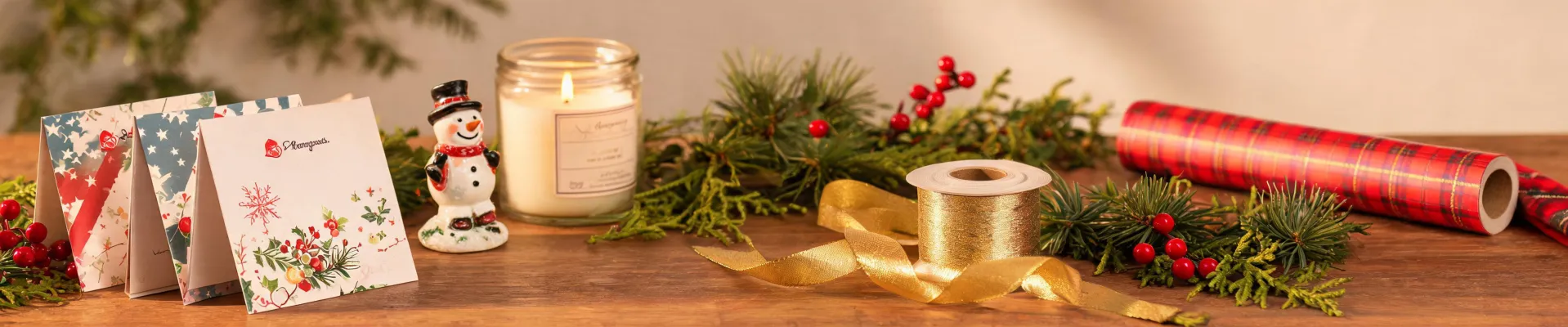
In 2022, I ordered 350 boxed Christmas cards for our company's client appreciation mailing. Nothing fancy—a standard American Greetings design, our logo on the back, the usual December timeline. The cards arrived on time. They looked fine in the box.
Then the comments started.
Three different clients mentioned the cards felt "flat." One said it in a way that made me wonder if she meant the design, the paper, or the entire gesture. I never got a clear answer. That bothered me more than any late delivery ever has.
That was the year I stopped treating holiday gifting as a to-do list item and started treating it as a brand decision. Here's what that shift cost me—and what it saved me.
You're Not Ordering Cards. You're Sending a Message.
Most corporate buyers approach holiday ordering the way I did for my first two years: find a product, compare prices, check the delivery window, done. It feels like a procurement exercise. It isn't.
Look, I'm an office administrator for a mid-size company. I manage all our gifting and printed materials—roughly $40,000 a year across eight vendors. I report to both operations and finance. I'm not a brand strategist.
But after five years of managing holiday orders for 400 employees across three locations, I've noticed something that's hard to unsee:
Every card, gift bag, and ornament you send is a physical handshake. It's the one time a year you're literally placing your company's name in a client's hands.
What most people don't realize is that a $0.60 card and a $1.20 card look nearly identical in a catalog image. Online? You can't tell the difference. In person? You absolutely can. The paper weight. The finish. The way the envelope feels when opened. Clients may not consciously register these details as "quality," but they register them as something.
Here's something vendors won't tell you: most corporate gifting catalogs are built for efficiency, not for impression. Distributors push the same 25–30 "popular" designs across every company they serve. Your "custom" order is often a logo dropped onto a template that hundreds of other businesses are also sending.
And that's the deeper issue. Corporate gifting has quietly been reduced to a transaction.
Clients feel the difference between a gift and a transaction. They just don't tell you about it directly.
The Real Costs Nobody Adds Up
Let me give you two specific numbers from our actual P&L.
In 2023, we switched to a budget supplier for holiday gift bags to save about $1.80 per bag. We ordered 250. Total savings: $450.
Then one of our largest clients used those bags for executive gifts at their December event. Two handles tore, in public, with executives watching.
Our contact didn't complain to us. But our account manager heard about it. And six months later, at renewal time, the same client pushed for an additional 3.5% discount. We gave back roughly $3,500 in concessions.
I don't have hard data proving the cheap bags caused that negotiation shift. Based on how the account manager described the calls, my sense is they played a role. The client never said "your gift bags were flimsy." But quality came up in the conversation. It always does when you cheap out on something the client physically handles.
A $450 savings that erodes $3,500 in margin isn't a savings. It's a loss with extra steps. Simple.
Here's another one. We once ordered Christmas cards from a discount wholesaler because the design looked great online. When the boxes arrived, the paper was so thin you could see the printing through from the other side. We threw out 300 unusable cards and reordered from American Greetings at nearly double the unit price. The "savings" from the first order evaporated, and we ate $650 in reorder and rushed shipping costs.
The worst part wasn't the money. It was the wasted week of back-and-forth, the second approval round, and the quiet hit to my credibility with my VP.
The Cost Nobody Tracks: Your Time
Here's what I wish I had tracked from day one: internal hours.
When a holiday order fails, it's not just the product cost. It's the research cycle. The vendor negotiation emails. The amended purchase orders. The conversations with finance about why we need to double the budget line. The follow-up with the account team to reassure them the issue is handled.
Roughly speaking, every failed order costs me six to eight hours of work. At our internal billing rate, that's $600–$1,000 in pure coordination cost. Add that to the reorder costs above, and the "budget" supplier option was never actually cheaper.
That's the thing about cheap sourcing: the price tag is visible, but the true cost hides in your calendar.
What Quality Actually Buys You
In 2024, I consolidated most of our holiday ordering through American Greetings. Not because they're the cheapest—they're mid-range on price. Because they're consistent. And after years of juggling three different suppliers across cards, gift bags, ornaments, and candles, consistency was worth more than whatever I saved on unit price.
The boxed Christmas cards come in designs that don't look recycled from someone else's corporate mailing. The gift bags hold actual weight—I tested the handles by loading them with a bottle of wine and a candle before ordering. The ornaments look like something a person would keep, not throw in a drawer.
Is their home fragrance line the best-smelling out there? I can't say that with certainty—I'm not a perfumer, and I haven't tested every candle brand on the market. But I can tell you the seasonal scents we ordered in fall 2024 drew more positive client comments than any other gift we've sent, including a premium wine basket we did in Year One. Take that with a grain of salt—it's anecdotal, not a controlled study. But it tells me something.
What quality buys you isn't just a nicer product. It's the quiet confidence that the thing you're sending represents you properly. When I hand a client a gift bag that feels substantial, I don't hold my breath wondering if a handle will tear. When I drop a boxed card in the mail, I don't worry about whether a client will unfold it and feel let down.
That certainty has real value. I can't put it on a spreadsheet, but I can feel it every time the holiday season rolls around and I'm not panicking.
What I'd Do Differently (Short Version)
If you're the person responsible for corporate gifting this year, here's what five years of mistakes taught me:
- Order samples before bulk. One of each candidate item, shipped to your desk. Evaluate paper weight, handle strength, scent quality. You'll learn more in thirty seconds of handling than from hours of catalog browsing.
- Calculate total cost, not unit cost. Add in the reorder risk, the shipping failures, and the value of your own time. The "cheap" option rarely survives that math.
- Buy from a source with genuine variety. If every company in your region sends the same three designs, your gift isn't a gift—it's bulk mail.
- Trust your own reaction. If you unbox a sample and think "this feels nice," that's a signal. If you think "it'll do," it won't.
I'm not a brand consultant, so I can't speak to sophisticated positioning strategies. What I can tell you from the procurement trenches is this: the physical things you send to clients are either quietly building your brand or quietly eroding it.
American Greetings gave us a way to make the "building" part consistent—cards, bags, ornaments, candles, all in one order, at a quality level I don't have to babysit. That's a small thing. But in this job, small things compound.
Nothing about this is complicated. The hard part is deciding that it matters. After five years and more than a few expensive lessons, I can tell you: it does.

Elise Laurent
Elise Laurent is a crystal and decorative glass quality analyst covering crystal figurines, vases, ornaments, suncatchers, and gift glassware. She examines ISO 6486-1 where food-contact glass dinnerware applies, then uses polarized strain inspection, dimensional checks, surface-defect grading, and refractive clarity to compare decorative pieces outside that scope. Her work helps sourcing teams choose materials, finishing routes, and protective packaging without confusing visual brilliance with verified durability.