-
1. What's the ordering process actually like?
-
2. Can I get American Greetings wedding cards for employee milestones?
-
3. Is the American Greetings app worth using for business orders?
-
4. Are jar candles actually a good corporate gift?
-
5. What should I check before choosing crystal gifts?
-
6. How do you clean a silver tea set at home?
-
7. What's the real cost per greeting card after postage?
I've been the office administrator who handles all our gift, greeting card, and seasonal decor ordering for about five years now. That's roughly $25,000 a year across eight vendors, including American Greetings. My company has 400 employees spread over 3 locations, so when I order, I order in bulk. These are the questions I actually get from other admin buyers—plus a few I learned the hard way.
1. What's the ordering process actually like?
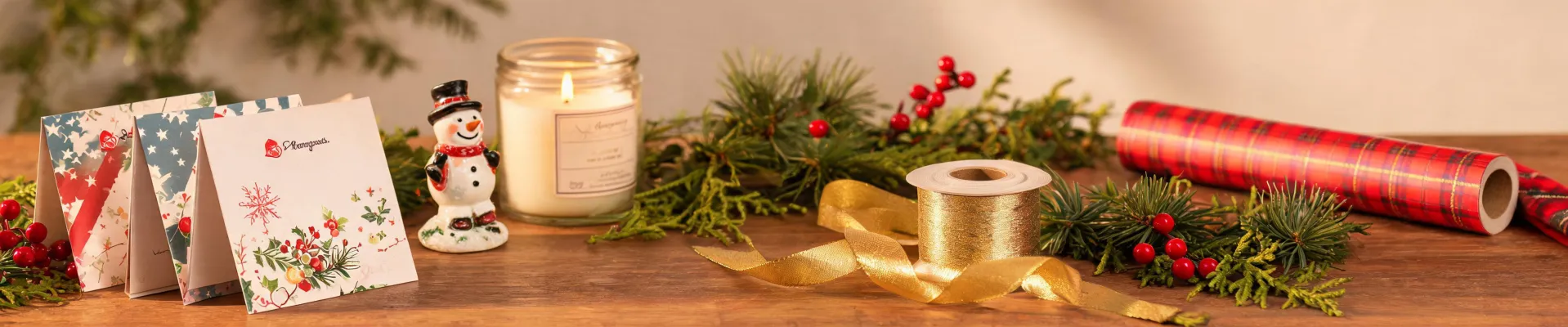
Straightforward, mostly. You create an account, browse by category, and submit your order. The product range is wider than you might expect—greeting cards, gift bags, wrapping paper, candles, candle holders, ornaments, small home decor pieces. That's one of the reasons we've kept American Greetings in our vendor rotation.
But here's the catch: not everything on the consumer site is available in bulk. I learned this in 2021 when we tried to order 200 units of a specific ornament for holiday client gifts. It showed as in stock, but the order got pulled into a different fulfillment batch because of the quantity, and delivery slipped. We got them in time, but it was closer than I'd have liked.
I've placed maybe 200 orders with them total. Maybe 180—I'd have to check our purchasing system. Either way, enough to learn the patterns.
2. Can I get American Greetings wedding cards for employee milestones?
Yes, and this might be the most common request I receive. We order wedding cards regularly, both for employees getting married and sometimes as part of a client gift package.
Three things to watch:
- Custom printing adds lead time. Names, dates, specific messages—plan on a week, but it can stretch closer to two once you count proof approval and shipping.
- Card size affects postage. USPS defines a standard letter as 3.5" x 5" up to 6.125" x 11.5" (pe.usps.com/businessmail101). Anything larger moves into the large-envelope rate.
- Print quality depends on resolution. Keep custom artwork at 300 DPI minimum at final size. A 3000 x 2000 pixel image prints at 10 x 6.67 inches at 300 DPI—anything less, and you'll see pixelation.
I once told our rep we needed cards "as soon as possible." They heard "whenever convenient." Result: delivery two weeks later than I expected, and an awkward conversation with my VP of operations. Now I always give a specific date.
3. Is the American Greetings app worth using for business orders?
Honest answer: depends on the order. The app is really built for consumers—it's great for sending a single card to a client straight from your phone. I actually like it for that. The interface is smooth, and scheduling delivery is easy.
For bulk orders, though, I use the website. I tried managing a 40-card order with multiple shipping addresses through the app once, and it wasn't a good experience. To be fair, the app never claimed to be a B2B tool—I just assumed the features would carry over. They didn't.
Personally, I now use the app for browsing new card designs and gifting ideas, then place the real order from my laptop. That workflow has worked well for me.
4. Are jar candles actually a good corporate gift?
I get this every December, and my answer is: yes, but do the math first.
Jar candles make strong client gifts because they feel like a real present. People actually burn them. There's something satisfying about giving a gift that doesn't end up in a drawer—we've had clients mention our candle gift months after receiving it.
But the total cost goes beyond the candle price. Shipping weight is a big one: a 12-ounce candle is heavy once you add the jar and packaging, and if you're shipping to multiple locations, freight becomes a real line item. Then there's breakage—glass breaks in transit, so check the packaging quality before ordering 150 units. And if you're choosing candles partly because of "eco-friendly" packaging, the FTC expects claims to be substantiated (ftc.gov/green-guides). Worth a quick check if sustainability is part of your brand messaging.
I calculated the numbers once for a 150-unit order. The per-unit price looked great. But after custom labels, bubble wrap, boxes, and freight, the all-in cost per gift was almost double. Still within budget, but I had to justify it to finance, so I wanted the real number.
5. What should I check before choosing crystal gifts?
Crystal is a premium gift category, and it's where I've seen the "cheapest quote" trap more often than anywhere else. Three things I check now.
First, the breakage policy. If 5% of the order arrives cracked, who replaces it? A vendor with a clear policy saves you from a headache later. The risk of paying for replacements out of your own budget is real.
Second, the actual material. I once ordered "crystal" awards for a retirement ceremony and they arrived as what was clearly high-quality glass, not crystal. If the gift is brand-critical, ask for the exact material spec.
Third, packaging costs. Custom foam inserts and double-boxing are sometimes quoted separately. Always ask for an all-in price that includes packaging.
The upside of a premium crystal vendor is that the gift gets remembered. The risk is blowing the budget. I worked out the worst case once—hundreds of dollars in replacements and a delayed ceremony. The expected value said go premium, but the cheaper quote looked more convincing when I presented it to finance.
Now I apply total cost thinking before comparing any quotes. A $500 quote that becomes $800 after shipping, setup, and replacement isn't cheaper than a $650 all-inclusive quote.
6. How do you clean a silver tea set at home?
Not what you expected from a corporate gifting article, right? But if you're buying silver tea sets as executive gifts—or keeping one in the client conference room, like we do—this becomes relevant fast.
For regular cleaning, warm water with a few drops of mild dish soap is enough—just dry it immediately with a soft cloth, or you'll get water spots. For tarnish, use a silver-specific polish with a soft, non-abrasive cloth and rinse thoroughly afterward. And avoid the two things that ruin more silver than anything else: baking soda paste on ornate pieces (too abrasive for fine detailing) and dishwashers. I once saw a $400 tea set come out of a dishwasher looking sandblasted.
Also, if you're comparing silver gifts from different vendors, check the labeling. Per FTC guidelines (16 CFR Part 23), "sterling silver" must be at least 92.5% silver. Look for the "925" stamp. There's plenty of silver-plated product out there sold in ways that blur the line—know exactly what you're gifting before it's sitting in front of the recipient.
7. What's the real cost per greeting card after postage?
The card itself is probably the smallest line item. Postage changes everything.
According to the USPS January 2025 rate adjustment (usps.com/stamps):
- First-Class Mail letter (1 oz): $0.73
- First-Class Mail large envelope (1 oz): $1.50
- Additional ounce for large envelopes: $0.28
If your card is larger than 6.125" x 11.5", it's no longer a letter—it's a flat, and the price jumps. Thick cards with embellishments, or cards bundled with gift cards, tip into higher weight tiers, and the per-unit cost climbs.
One more thing: per federal law (18 U.S. Code § 1708), only USPS-authorized mail may be placed in residential mailboxes. This never mattered to me until a sales manager asked if we could have a courier drop client gifts directly into their home mailboxes. The answer is no, and the fine can reach $5,000 per occurrence. Good to know before you promise it.
My rule: calculate the landed cost per recipient—card + envelope + postage + the time it takes someone to stuff and address them. That last item is probably the most overlooked part of the cost. When I switched to online ordering and streamlined our card-sending process, we cut about six hours of monthly administrative work down to one. That's the kind of savings that shows up beyond the invoice.

Elise Laurent
Elise Laurent is a crystal and decorative glass quality analyst covering crystal figurines, vases, ornaments, suncatchers, and gift glassware. She examines ISO 6486-1 where food-contact glass dinnerware applies, then uses polarized strain inspection, dimensional checks, surface-defect grading, and refractive clarity to compare decorative pieces outside that scope. Her work helps sourcing teams choose materials, finishing routes, and protective packaging without confusing visual brilliance with verified durability.