I Believe Most Greeting Card Businesses Fail for the Wrong Reason
People think the greeting card industry is about creativity. Beautiful designs. Witty sentiments. That's what sells, right? I think that's backward.
In my role as an emergency specialist for print and packaging, I've seen the same pattern repeat. A company with gorgeous cards goes under. A startup with mediocre designs but flawless logistics thrives. The margin isn't in the art—it's in the system.
So here's my take: The greeting card business is profitable. But only if you stop treating it like an art project and start treating it like a supply chain problem.
Why Most People Get Greeting Card Profitability Wrong
The assumption is that greeting cards are a low-margin, high-volume business. You need to sell thousands to make anything. Actually, the reality is more subtle. The margin per card can be excellent—if you control your costs before the design hits the press.
Let me give you an example. Last quarter, I worked with a client who was losing money on every custom card order. They had a beautiful design—embossed cover, foil accents, custom envelope liners. But they were paying $4.50 per unit for a 1000-unit run. The client was selling them for $6.95. Gross margin looked okay until you factored in the 15% return rate because the foil registration was off on 2% of the order. (Should mention: they didn't catch it until after shipping.)
People think expensive design drives profitability. Actually, profitable design is about what you decide not to do.
Three Things I've Learned About Making Greeting Cards Profitable
Based on our internal data from about 400 rush jobs—maybe 370, I'd have to check the system—and a dozen post-mortems on failed product launches, here's where I see the real profit levers.
1. The Format Decision is a Margin Decision
Standard A2 cards (4.25" x 5.5") are the workhorse for a reason. They fit USPS standard envelope dimensions (USPS defines letter size as 3.5" x 5" to 6.125" x 11.5"). They ship in bulk without surcharges. They print 4-up on a standard press sheet.
Every time a client asks for a square card, I cringe. Square envelopes require non-machinable postage. According to USPS pricing effective January 2025, a standard letter is $0.73. A square envelope starts at over a dollar. And that assumes it fits. If it's over 6.125" x 11.5", you're in flat territory—$1.50 just to mail it. That eats your margin before you've printed a single card.
I still kick myself for not pushing back harder on a client who insisted on 6" x 6" cards for a corporate order. The postage alone killed the unit economics. We delivered on time. The client loved the design. But they never re-ordered because the total cost was too high for their budget.
2. Envelopes Are Where Good Margins Go to Die
This sounds trivial. It's not. A standard #10 envelope with a 1-color print might cost $0.15-0.30 each in a 500-run (per online printer quotes, January 2025). But add a second color? Custom window placement? That $0.30 jumps to $0.60+.
Here's what tripped up a client in March 2024. They designed a beautiful card with a belly band and a custom envelope liner. The card itself cost $1.80. The envelope assembly—liner, band, custom address panel—added another $2.20. They were selling the set for $5.99. Margin looked okay until they realized the belly band required hand-applied adhesive. That added labor cost. And the liner had to be cut to size, which added 1% waste per sheet. Small numbers. But on a 5,000-unit order, that's 50 wasted envelopes at $0.60 each. That's $30. Not huge. But it compounds.
The most profitable greeting card products I've seen use stock envelopes. Maybe with a foil stamp on the flap. That's it.
3. The Packaging is Part of the Product—and the Cost
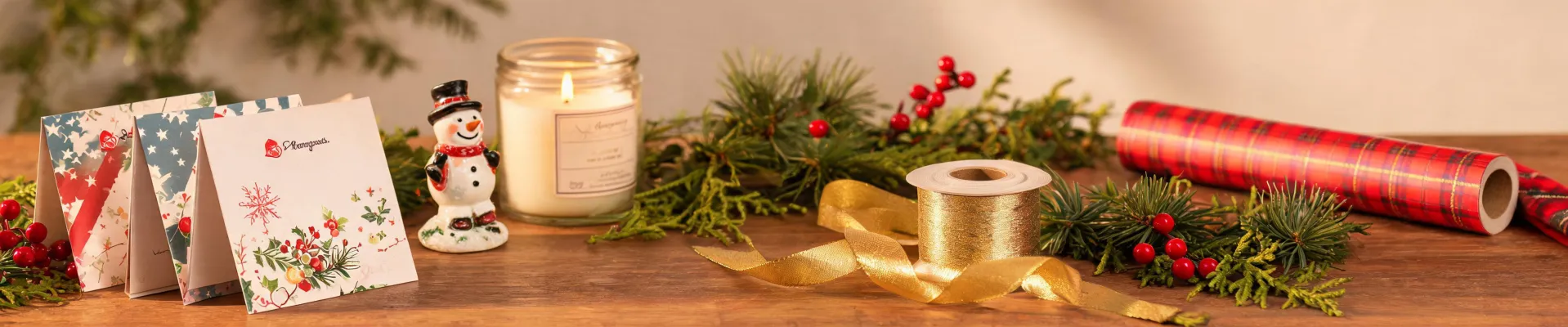
This is where 'American Greetings' has something figured out. They sell not just cards, but coordinated gift bags, wrapping paper, and candle holders. The wrapping paper works with the card. The gift bag coordinates with the ornament. It's a system.
For a B2B buyer, this matters. If I'm ordering corporate gifts for 200 clients, I don't want to source a card from one vendor, a gift bag from another, and a candle from a third. I want one vendor who can deliver a complete American Greetings set: card, bag, tissue, ornament, maybe a small candle. That saves me 80% of the procurement admin time.
But here's the catch. That bundling is a cost optimization for the buyer, not the seller. From the seller's side, you have to manage inventory across 12 SKUs instead of 1. That's where the 12-point checklist I created after my third mistake has saved us an estimated $8,000 in potential rework.
The Objection I Hear Most: "But customers want unique designs"
I get why people say that. The greeting card market is crowded. You need to stand out. But standing out doesn't mean exotic formats. It means execution.
I'd rather deliver a standard-format card with perfect foiling, on thick stock, with a handwritten-style font that feels personal—than a square card with a belly band that arrives with a bent corner because the envelope didn't fit in the sorting machine.
Reliability is a differentiator. Especially in B2B. When I'm ordering holiday cards for my company's clients, I don't want a surprise. I want them to arrive on time, looking exactly like the proof, at the price I agreed to.
So Is the Greeting Card Business Profitable?
Yes. But the profit isn't in the creativity. It's in the decisions you make before you print.
Format. Envelope. Packaging. Vendor selection. Those are the levers. 5 minutes of verification beats 5 days of correction. A standard format might feel boring, but it's the difference between a 30% margin and a 5% margin.
I have mixed feelings about saying that. Part of me wants to celebrate the artistry of greeting cards. Another part knows that the companies that survive—and thrive—are the ones that treat the card as a manufactured product, not a piece of art. Maybe that's unromantic. But it's profitable.

Elise Laurent
Elise Laurent is a crystal and decorative glass quality analyst covering crystal figurines, vases, ornaments, suncatchers, and gift glassware. She examines ISO 6486-1 where food-contact glass dinnerware applies, then uses polarized strain inspection, dimensional checks, surface-defect grading, and refractive clarity to compare decorative pieces outside that scope. Her work helps sourcing teams choose materials, finishing routes, and protective packaging without confusing visual brilliance with verified durability.