The pallet showed up on a Monday morning
December 9, 2024, 9:40 a.m. The freight carrier dropped the pallet at our loading dock, and I watched two guys cut the shrink wrap off like they were unwrapping a birthday present. I remember feeling pretty good about myself. The order was early. The order was fine.
It was not fine.
Sixty of the shirt gift boxes had crushed corners — not destroyed, but the kind of damage you notice immediately, and so would a client. And about half of those, once we got them open, turned out to be roughly an inch and a half too shallow for what we were putting inside.
That second part wasn't the carrier's fault. That was mine.
Rewind: how we got there
I coordinate corporate gifting for a mid-size distribution company — roughly 340 client contacts, plus 90-some internal staff. Every December we send a gift set to the client list. Nothing extravagant. Something people actually keep.
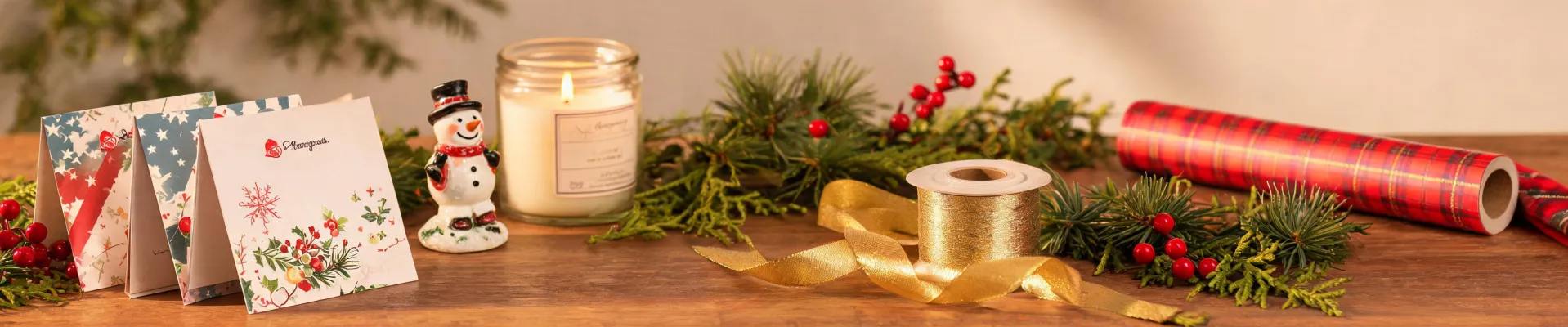
For 2024 we landed on: a jar candle, a keepsake ornament, a greeting card, and a shirt gift box holding a branded tee. We sourced the cards — the American Greetings Christmas cards line, specifically — along with the candles, ornaments, and boxes through American Greetings. That part of the process was genuinely the easy part, mostly because the catalog is broad enough that we weren't cobbling together four vendors for four categories.
Order went in on October 28, 2024. Standard lead time was quoted at three to four weeks, which put arrival somewhere between December 5 and 9. Our plan was to assemble the week of the 9th and ship to recipients by December 16.
Why December 16? Because USPS listed December 18, 2024 as the cutoff for Ground Advantage to arrive by Christmas. I wanted two days of buffer. Verify that date at usps.com if you're planning for this year — it moves around.
Now the clock
So here's where I was on December 9: 11 days to Christmas, a half-damaged pallet, and a spec problem I'd created myself.
Had about two hours to figure out the path forward before I needed to commit to something. Normally I'd get three quotes and sleep on it. There was no sleeping on it.
I laid out four options on a whiteboard:
- Reorder the boxes. Seven to ten business days. Wouldn't clear by the 16th. Dead on arrival.
- Use kraft mailers instead. Cheap, fast, and would have completely undercut the whole point of a gift set that was supposed to feel like something.
- Ship the damaged ones anyway and hope nobody noticed. I've done this before. It's a bad trade.
- Find a local packaging shop that could run custom boxes in 48 hours. More expensive, but real.
I called a local shop about 20 minutes from our warehouse.
The part where I did the math I didn't want to do
The upside of options two and three was roughly $1,200 in savings. The risk was simple: 60 clients get a gift that looks like it was assembled in a hurry. And I had one account — a property management group doing about $60,000 a year with us, with a renewal conversation in January — that had already given us a heads-up about not wanting anything that looked templated.
I kept asking myself: is $1,200 worth potentially walking into that January call with an apology?
Worst case: bad packaging, a client or two notices, the renewal gets harder. Best case: I save $1,200 and nobody says anything either way. The expected value math said take the savings. The downside felt catastrophic anyway.
I went with the local shop.
The surprise wasn't the price
Never expected the local shop to catch something I'd missed. Turns out they looked at my spec sheet, measured a folded tee and tissue paper themselves, and told me the box needed 1.5 inches more depth before they'd even quote it.
That's the error that had been buried in the pallet. I'd spec'd the shirt gift box off a dimension I pulled from a listing, not off an actual folded shirt. If you've ever read through shirt gift box reviews trying to figure out why people are unhappy, it's usually the same complaint: it looked deeper online.
They also caught that our original board stock was lighter than what we needed for a box that was going to get stacked inside a mailer. So the “expensive” local option ended up being a higher-quality box than what we'd ordered back in October.
Two of the 60 damaged boxes we salvaged. The rest we re-ran. Forty-eight hours, door to door.
The question I got from a client mid-crisis
Meanwhile, the property management contact emailed me with a separate question — she was putting together a lobby display and wanted to know if she could mix the Christmas pieces we sent with the everyday decor already in the space.
Yes. And honestly, I'd rather see that than a fully themed display.
What works, based on what I've watched clients do: pick one neutral base layer — warm woods, matte brass, linen, kraft — and let the holiday items be maybe 20 to 30 percent of the arrangement. An ornament sitting in a bowl that's already on the table reads as intentional. Twelve ornaments on a shelf next to a year-round ceramic piece and a stack of unread books reads like a room that hasn't decided what it is.
The jar candle is the easiest bridge, by the way. A candle in a neutral vessel works in January as well as December. That's probably why it was the single most-complimented item in the whole set.
Put another way: the Christmas decor isn't the theme. It's the accent.
How it ended
We assembled December 11 and 12, shipped December 13 and 14. Three hundred thirty-seven of 340 landed. Three came back undeliverable — bad addresses we should have caught in November.
No client complained about the boxes. Two asked where the candle came from. The property management renewal went through in January without much drama, though I'll never know for sure how much that had to do with a gift set.
The numbers, and what I actually learned
Quoted: $22.40 per unit. Here's what it ended up being, all figures as of December 2024:
- Base product, 340 units: $7,616
- Inbound freight to our dock: $610
- Local reprint of 60 boxes: $780
- Overnight on the corrected-depth stock: $340
- Four people, two evenings of packing overtime: $520
- Three undeliverable units: $67
Total: $9,933. That's $29.21 per unit, not $22.40.
The local shop's all-in quote for the same volume — if I'd called them in October instead of December — came to about $26.50 per unit, everything included. $9,010. Roughly $923 less than what we paid, for a better box.
I'm not 100% sure that October number would have held. December pricing is its own animal, and small shops book up. Take the comparison with a grain of salt. But directionally, the “cheaper” option wasn't cheaper. It was the more expensive option with the invoice split across four vendors.
Here's what you need to know: the quoted price is rarely the final price. It's just the first one.
What I do now, and what I'd suggest if you're building a holiday gifting program:
- Price the whole thing, not the unit. Freight, rush fees, overtime, returns, and reprints are all part of the number.
- Verify dimensions against the actual contents. Fold the shirt. Measure the tissue. Then spec the box.
- Put the buffer in the schedule, not the budget. Two days of slack cost us nothing. Two days of emergency cost us $923.
- Find one local vendor before you need them. Not to order — just to know who you'd call.
I can only speak to our situation, and ours is a mid-size B2B company with a predictable list and a single December push. If you're dealing with a list that changes weekly, or international shipping, or a retail side of the business, the calculus is probably different.
But the framework holds. Add up everything it will actually cost — including the parts you're hoping won't happen. That's the number you're comparing.

Elise Laurent
Elise Laurent is a crystal and decorative glass quality analyst covering crystal figurines, vases, ornaments, suncatchers, and gift glassware. She examines ISO 6486-1 where food-contact glass dinnerware applies, then uses polarized strain inspection, dimensional checks, surface-defect grading, and refractive clarity to compare decorative pieces outside that scope. Her work helps sourcing teams choose materials, finishing routes, and protective packaging without confusing visual brilliance with verified durability.