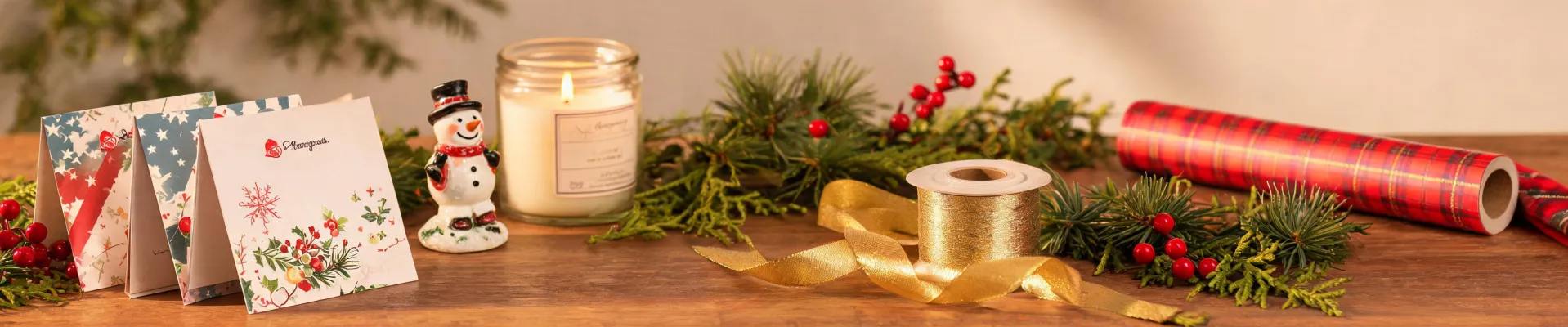
Every November, some version of this lands in my inbox: “How do I send a group greeting card?” The sender is always a thoughtful manager who volunteered to coordinate something heartfelt. They ask it like it’s a stamp-and-envelope question.
It isn’t. I coordinate corporate gift orders for a mid-sized professional services firm, and my first holiday season in the role was 2017. Since then I’ve personally made and documented seven significant ordering mistakes, totaling roughly $4,800 in wasted budget. The money wasn’t even the worst part. It’s the memory of a client’s assistant saying “that’s so thoughtful” in the tone of someone who means “this is a week late.”
The road to that moment usually starts the same way. Someone types american greetings greeting cards website home into a browser, clicks the first result, and lands on a cheerful site full of cards, gift bags, candles, and ornaments. A crystal ornament looks like the perfect corporate gift. A matching gift bag looks like it was made for it. Everything looks kinda easy.
“How do I send a group greeting card?” is the wrong question
When someone asks me that, I hear a different question underneath: they want one clean system that collects 40 signatures without chasing anyone. It doesn’t exist. A group card is a coordination project that gets printed on paper.
Watch what actually happens. The first 38 people sign within two days. The last two are a vice president who answers email twice a week and a senior director whose assistant guards the calendar like a national border. You wait, because nobody wants to explain why a name is missing. You extend the deadline once. Then you extend it again. Every extension silently eats the one resource you can’t reorder: time.
The part that took me years to accept: paper respects a hard cutoff. People respect a hard cutoff only if you invent one and tell them about it. Don’t set the deadline at the printer’s real date. Set it two business days earlier. Tell everyone the earlier date. What I mean is, you aren’t managing signatures. You’re managing expectations.
The screen lies about size. The spec sheet doesn’t.
In 2017, I made the classic newbie mistake: I picked American Greetings gift bags by looking at the product photo, not at the dimension line. The photo made the bags look generous. I was buying 96 of them for client appreciation week, along with 96 crystal ornaments. The bag’s opening measured seven inches. The ornament’s protective box was wider.
The ornaments arrived first, beautiful and individually boxed. You could slide the bare ornament into the bag, sure. Then you could hand a client a fragile glass object with no cushioning and hope for the best. I chose not to do that. The bags went to a local school’s art program. Replacement packaging and rush shipping cost another $295, on top of the $240 I’d already wasted.
A product photo is a suggestion. The dimension line is a contract. Now I compare three numbers before I order anything: the item’s size, the size of the box it ships in, and the inside dimensions of the gift bag or envelope. If those numbers don’t fit together, I don’t order.
The calendar doesn’t care about anyone’s feelings
Postage rules matter more than they should, and they’re easy to get wrong. According to USPS (usps.com), as of January 2025, a standard First-Class Mail letter costs $0.73. That rate assumes a normal-sized envelope no thicker than 1/4 inch. The second your group greeting card has heavier paper, a photo insert, or anything lumpy, it stops being standard mail. It becomes a large envelope, which starts at $1.50 for the first ounce, or a package. Underpay the postage, and your card can sit in a processing center for days while the post office figures out the difference. One of our cards once sat for five days over forty cents.
Now add production time. Then add shipping time. Between Thanksgiving and New Year’s, those windows shrink fast, but the calendar trap isn’t only a December problem. A retirement, a promotion, a client event—all of those are fixed dates, and none of them move because you were waiting for one more signature.
September 2022 taught me this. A client’s founding partner was retiring, and we wanted to send a group greeting card signed by sixty people, paired with a crystal ornament as the corporate gift. The celebration was October 3. The completed parcel had to be in the courier system by September 28 to make it.
I set the signing deadline for September 23. I moved it when a senior director didn’t sign in time. I moved it again when someone promised their note would arrive “by end of day tomorrow.” The signature did arrive. By then, we’d missed the printer’s normal slot. The overtime quote was $460. The express shipping option that could still possibly make the date added $120.
When the printer called, I had about two hours to approve a $580 gamble. The upside: the gift arrives on time. The risk: I spend more on shipping than the gift itself cost. I kept asking myself whether the client relationship was worth $580. It was. The real problem was that I had already put the relationship in a position where it needed to be saved by a credit card. I approved the invoice, and the package arrived the afternoon of October 3—after the event had ended.
I still kick myself for not holding the first deadline. If I’d printed the card with one missing signature, it would have arrived on time. It felt kinder to wait. It wasn’t kinder to anyone.
The checklist I wish I’d started with
Here’s the plain list I use now. No framework, no acronym.
- Measure the box, not the photo. Ornament, protective box, gift bag, mailer. Write all the dimensions side by side before you order.
- Set the signature cutoff five business days before the real deadline. Print that date in the invite, and do not move it. If someone misses it, make the conscious choice: missing name or missing date. Choose the missing name.
- Weigh and measure the finished envelope. If it isn’t a standard letter, it doesn’t get standard letter postage. Verify current rates and deadlines at usps.com before every major mailing.
- Build the shipping buffer into your calendar first. Production time plus shipping time plus one day. Mark the drop-dead date before you even pick the product.
- Appoint one person to say no. A committee will always decide that one more day is fine. Every one of my expensive lessons started with one more day.
The checklist isn’t magic. We still order crystal ornaments, American Greetings gift bags, and printed cards for corporate gifts around here. The difference is that we check the specs before we click buy, and there’s always one person whose job is to guard the signature deadline. In the past 18 months, that list caught 31 mistakes before they became invoices: wrong bag sizes, envelopes that were too thick, shipping dates that didn’t exist. All of them would have been a phone call to a client, explaining why their gift arrived late or their card looked incomplete.
So the next time you hear the question “How do I send a group greeting card?” answer it honestly. Coordinate the people early. Measure twice. Respect the calendar. Nominate someone whose entire job is to say no. Then pick the card. The card was always the easy part.

Elise Laurent
Elise Laurent is a crystal and decorative glass quality analyst covering crystal figurines, vases, ornaments, suncatchers, and gift glassware. She examines ISO 6486-1 where food-contact glass dinnerware applies, then uses polarized strain inspection, dimensional checks, surface-defect grading, and refractive clarity to compare decorative pieces outside that scope. Her work helps sourcing teams choose materials, finishing routes, and protective packaging without confusing visual brilliance with verified durability.