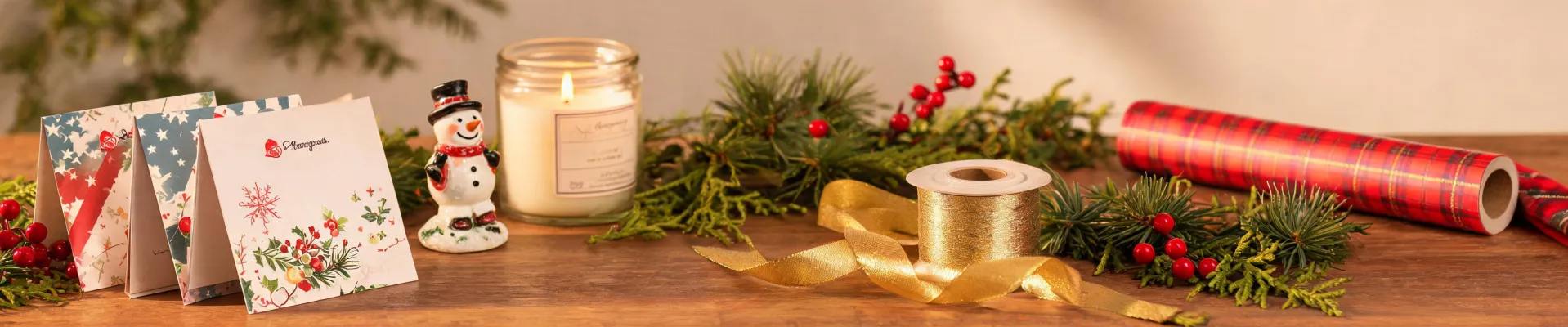
The Visible Defect Is Just the End of the Story
When I first started reviewing corporate greeting cards and gifts before they ship, I assumed my job was to catch visible defects: a smudged print, a crooked ribbon, a candle wick that shifted. Four years later, I have a less flattering answer. Most quality failures are decided before production starts. The visible defect is just where the problem finally shows up.
At American Greetings, I work on the quality and brand compliance side of the business. I review finished pieces before they reach customers, and I also review the failures that cost real money: rejected batches, late replacements, gifts that looked good in a photo and fell apart in a warehouse. In Q1 2024, my audit log showed a common pattern. “Looks wrong” was rarely the issue. “Wrong for what we agreed” was the issue.
Walk into an American Greetings store display and the card aisle looks orderly. A row of American Greetings Christmas cards feels consistent. That consistency is not an accident; it is the result of a quality standard being written down. For B2B buyers, that standard is often invisible until the moment it isn’t.
The Mockup Is a Promise, Not a Product
It’s tempting to think that if the mockup looks right, the bulk order will look right. The mockup usually contains one perfect version of the product, made by someone who is not under deadline, on equipment that is not in the middle of a 50,000-unit run. A personalized gift is not one product; it is a small supply chain: paper, print, assembly, box, and maybe a candle or ornament inside. Every component can be acceptable on its own and fail in combination.
Most buyers compare the obvious numbers: unit price, lead time, and front-of-card design. They overlook envelope dimensions, card thickness, wax behavior, and packaging claims. The question everyone asks is, “Will the recipient like it?” The question I ask first is, “Will this product still be acceptable after sitting in a distribution center for two weeks?”
I do not mean the supplier is dishonest. I mean the mockup is optimized. Production is not. That is why the most expensive quality mistakes I see are rarely about aesthetics. They are about the details that were never written down.
Gel Wax Reminded Me Why Temperature Belongs in the Contract
One phrase that keeps appearing in search logs is “how to melt gel wax for candle making.” For a hobbyist, that is a reasonable DIY question. For a manufacturer, it is a warning sign. If a customer is searching for a fix after receiving the product, the product has already failed.
Gel wax is not paraffin. It should be melted slowly to the temperature specified by the wax manufacturer—usually in the 200–220°F range, depending on the formula. Fragrance has to be added at the right temperature, the glass needs to be clean and prepared, and the candle should be cooled slowly. If any of those steps are rushed, you get air bubbles, sinking wicks, or gel that pulls away from the glass.
I learned this the expensive way. I still kick myself for approving a gel candle sample that was never tested in a warm room. The sample looked flawless at 68°F. When 8,000 units sat in storage conditions, the gel contracted and pulled away from the glass. That quality issue cost us a $22,000 redo and delayed the launch by two weeks. The defect was not a design failure. It was a missing test condition.
The Hidden Cost Is Often Postal, Not Visual
Corporate greeting cards have a hidden quality gate that has nothing to do with how they look: the mailbox. According to USPS pricing effective January 2025, a First-Class Mail letter (1 oz) costs $0.73. A First-Class Mail large envelope starts at $1.50. The difference is $0.77 per card. On a mailing of 25,000 American Greetings Christmas cards, that difference is $19,250 before a single person opens an envelope.
USPS Business Mail 101 also defines letter-size dimensions: a letter can be up to 6.125 × 11.5 inches and no more than 0.25 inch thick. Exceed those limits, and the piece may not qualify for the letter rate. A card that feels “premium” because it is thick, rigid, or in a decorative envelope might also cost more to send. Quality inspectors do not choose dimensions to annoy designers; they choose them to prevent a postage surprise.
Eco-Labels and Green Claims Are a Quality Check, Too
Another place gift quality goes wrong is on the label itself. If a product or its packaging says “recyclable,” “green,” or “biodegradable,” the claim has to be substantiated. Under the FTC Green Guides, a product claimed as “recyclable” should be recyclable in locations where at least 60% of consumers have access to recycling facilities. This is not a marketing nuance. It is a regulatory floor. A quality check should include what a product says about itself, not just what a product looks like.
Prevention Is Not a Process; It’s a Specification
I do not believe in checking quality at the end and hoping quality survives. Prevention is about putting a few details into the order before production begins:
- Ask for a production sample made with the final paper stock, candle gel, and finishing method—not a design mockup.
- Define physical measurements and tolerances: card size, envelope size, box size, and candle container fill level.
- Define environmental conditions: what is the lowest and highest temperature the gift will encounter before it is opened?
- Agree on first-article approval, and consider a small pilot run before you commit to the full production run.
- Review every word on the label and in the marketing copy. If you claim it is recyclable or eco-friendly, make sure you have the substantiation to back it up.
Five minutes of verification beats five days of correction. The same standard that makes an American Greetings store rack of greeting cards feel dependable can be applied to a bulk order of personalized gifts—but only if the buyer and supplier agree on what “good” means before the supplier starts running.
When a gift works, nobody sees the quality process. When a gift fails, the process is all anyone talks about. That is why quality control is not the last step. It is the first specification.

Elise Laurent
Elise Laurent is a crystal and decorative glass quality analyst covering crystal figurines, vases, ornaments, suncatchers, and gift glassware. She examines ISO 6486-1 where food-contact glass dinnerware applies, then uses polarized strain inspection, dimensional checks, surface-defect grading, and refractive clarity to compare decorative pieces outside that scope. Her work helps sourcing teams choose materials, finishing routes, and protective packaging without confusing visual brilliance with verified durability.