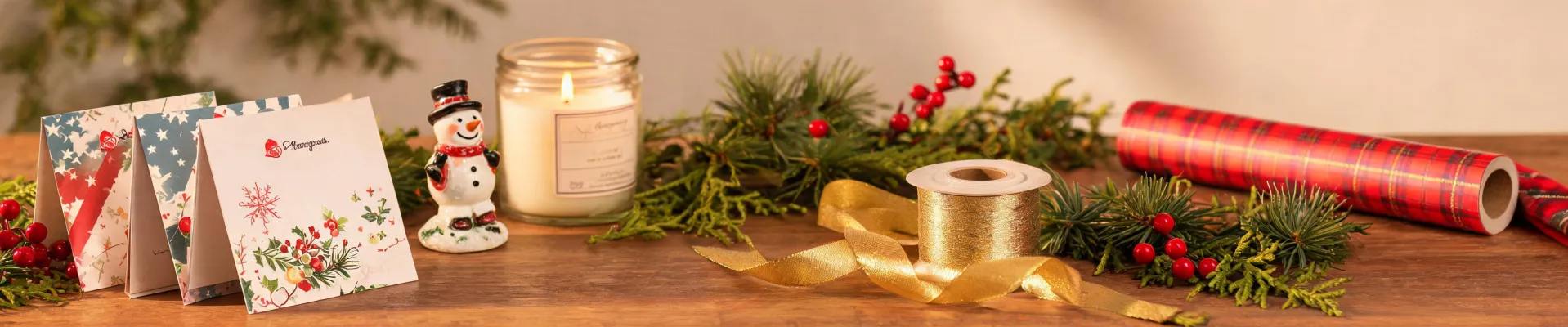
On the second Tuesday of September 2024, I walked into our sample room and found two long tables covered with mock corporate gift sets. We were producing a 5,000-unit holiday program for a regional bank. Every set was supposed to include an American Greetings Christmas card, a scented votive candle in a small holder, and a promotional bag with two or three smaller gifts tucked inside.
My role is quality/compliance manager. I sign off on nearly every deliverable that goes out to our clients. Over the past four years, that has meant reviewing around 200 unique items annually. It is not the most popular job during busy season. But I've learned that the distance between a digital proof and a physical sample is where brands go to lose trust.
The First Round of Samples
We had chosen American Greetings Christmas cards as the anchor of the set. Not because greeting cards are traditional, but because the card would be the one item recipients would open and actually read. The first sample passed. The card stock felt substantial—100 lb cover, roughly 270 gsm. At 300 DPI, the holiday art was sharp, with no visible banding or muddy red.
The votive candle passed too. I burned two samples for two hours. The flames stayed straight, the wicks didn't curl into mushrooms, and the labels left no sticky residue. Another thing I check: labels that slide after sitting in a warm box. That seems small until it ruins a batch of otherwise good candle holders.
The Problem Was the Bag
The trouble came with the outer bag. The plan was to use a custom tote bag printed with the bank's logo. We had specified Pantone 286 C, a deep corporate blue. On screen, the proof looked fine. When the physical sample arrived, the logo was clearly too purple. A Delta E difference above 4 is visible to most people. Our measurement came in around 5.4—I might be misremembering the exact decimal, but it was not close.
According to Pantone Color Matching System guidelines, the standard tolerance for brand-critical colors is Delta E below 2. A color difference above 4 is noticeable to most untrained observers.
The vendor said the bag was within normal promotional-product tolerance. For a bank, that wasn't a risk worth taking. We rejected the bag and changed the whole approach.
To be fair, the root issue went deeper. We had approved that design from a PDF proof, not from a physical printed sample. We didn't have a formal process that required physical proofs for custom packaging. I'm still not sure why we let ourselves skip it that time. My best guess is everyone was under pressure, and the design looked good on a monitor. That rejection cost us eleven days, and I still kick myself for not catching the gap earlier.
What's the Best Bag for Promotional Products? My Answer Changed
Once the tote was out, our internal Slack channel lit up with the same question: what's the best bag for promotional products? I used to have a simple answer: a 6 oz cotton canvas tote with reinforced handles. That is still a good answer for a trade-show giveaway. But this program taught me a better answer. It depends on whether the bag is supposed to be the product or the packaging.
For a corporate gift set built around greeting cards and candles, the best bag is not another promotional product. It is packaging that makes all the pieces feel like a single intentional gift.
We ended up using a structured American Greetings gift bag, paired with a branded belly band around the outside and a bit of tissue around the candle. I'll admit I was skeptical about paper gift bags for a 5,000-unit order. Paper bags can crush in transit. But this one had enough structure and a reinforced bottom. It also eliminated the original color issue, because the logo was printed on the belly band and not directly on bag material.
What I'd Do Differently
We shipped with nine days to spare. The client's employees sent photos of their sets, and the client rebooked a similar program for spring 2025. A repeat order is the strongest quality metric in my book.
Looking back, the lesson wasn't that custom totes are bad or that premium gift bags are good. It's that quality perception is brand perception. The card and candle did their job. The bag almost undid it because of a color mismatch that a physical proof would have caught earlier.
My approval checklist now includes four steps:
- Always require a preproduction physical sample for any printed packaging or promotional product.
- Compare printed color to a physical Pantone swatch under daylight, not only under office LED lighting.
- Burn-test any candle before committing to a large run, and check labels after temperature cycling.
- Test the bag with the actual contents inside, not with an empty sample.
If you're planning holiday cards, votive candles, or corporate gift bags, leave room in your schedule for that physical-sample round. American Greetings products held up through the whole process, but they still deserved the same scrutiny as any custom printed piece. And the next time someone asks me what's the best bag for promotional products, I'll answer with a question: what are you putting in it, and what do you want them to feel when they open it?

Elise Laurent
Elise Laurent is a crystal and decorative glass quality analyst covering crystal figurines, vases, ornaments, suncatchers, and gift glassware. She examines ISO 6486-1 where food-contact glass dinnerware applies, then uses polarized strain inspection, dimensional checks, surface-defect grading, and refractive clarity to compare decorative pieces outside that scope. Her work helps sourcing teams choose materials, finishing routes, and protective packaging without confusing visual brilliance with verified durability.