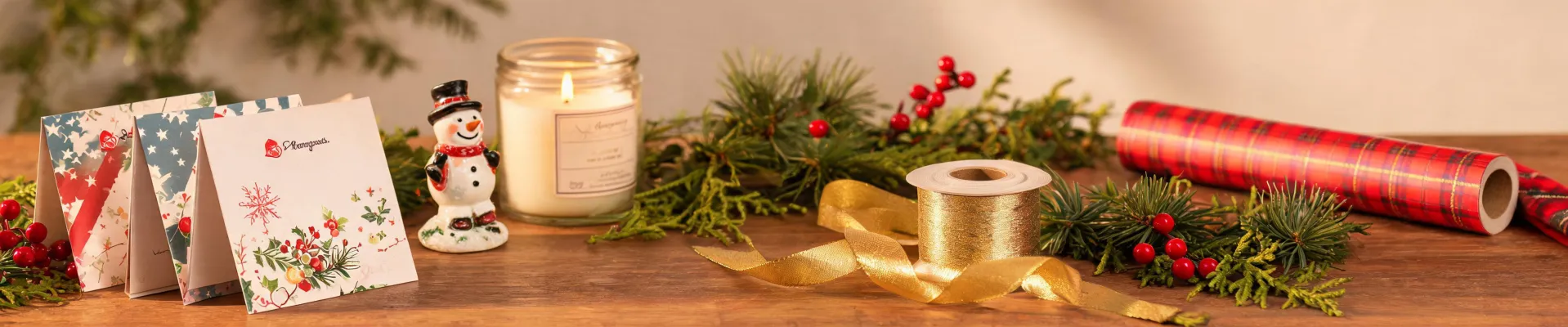
Last holiday season, I reviewed a 2,400-unit order of custom Christmas ornaments. The quote was 18% below the closest competitor. The ornaments arrived with the client's red logo looking almost pink, and the imprint was 2mm off-center. The vendor called it 'within industry standard.' It wasn't.
I'm a quality and brand compliance manager at American Greetings. I review every custom corporate gift order before it ships—roughly 250 items each month. In the 2025 review cycle, through April, I've rejected 11% of first-article samples because of color mismatch or spec drift. The pattern is consistent: someone picked the lowest price and left the specifications too vague. This isn't a lecture about cheap versus expensive. It's about total cost.
The Surface Problem: The Lowest Quote Wins
Budget pressure is real. When a sourcing request says 'corporate gifts, 5,000 units, need by December,' the natural instinct is to compare unit prices. Greeting cards, wrapping paper, and ornaments start to look like commodities. They're not.
A typical request I get sounds like this: 'We need 5,000 holiday gifts. Can you beat this quote?' I understand the question, but it's incomplete. A quote means nothing if the product misses its spec. The better question is, 'Can you meet this spec at this price?' Without a spec, 'lower' is just a number.
What's Actually Going Wrong
The root cause isn't greed or incompetence. It's ambiguity. Most failures I see in quality review trace back to a vague requirement that got interpreted in the supplier's favor.
The Specifications Are Too Vague
I do not mean that every order needs a museum-grade specification. I mean the basics are frequently missing: Pantone colors, paper weight, print resolution, finish, tolerance for variation, and packaging requirements.
Take color. Pantone Matching System guidelines set acceptable tolerance for brand-critical colors at Delta E < 2. Delta E of 2-4 is noticeable to trained observers; above 4 is visible to most people. Reference: Pantone Color Matching System guidelines. If your supplier does not know your Delta E target, they're guessing. And when they guess, red becomes pink.
Print resolution is another one. Commercial offset printing needs 300 DPI at final size. If a supplier accepts a 72-DPI logo from your marketing team because 'it'll be fine,' it won't be. For wrapping paper and greeting cards, paper weight matters too. A 100 lb cover (270 gsm) feels substantial. An 80 lb cover (216 gsm) feels thinner. Neither is 'wrong'—but you need to choose, not let the warehouse choose for you.
The same applies to wrapping paper. If you're buying American Greetings Christmas wrapping paper in bulk, specify the paper weight and the pattern repeat. A sheet that's too thin tears before the gift gets to the recipient. A pattern that isn't registered properly looks like a knockoff, and that reflects on your brand.
The Hidden Costs Are Part of the Price
The unit price is the number on the invoice. The total cost includes your time checking proofs, answering follow-up emails, arranging returns, and managing the schedule when something slips. That's where cheap orders get expensive.
Why does this matter? Because time is not free. In one case, a $200 savings on an order became a $1,500 problem after a rushed reprint had to be airfreight-shipped a week before the client event. The original supplier didn't cover the airfreight. The client didn't care whose fault it was. They just wanted the gifts on time.
A cheaper vendor may also have a longer standard lead time. When they miss the deadline, you pay for expedited shipping, your staff pays overtime, and the gift arrives too late to matter. From my own review notes, the lowest-priced supplier required rework or replacement in roughly 60% of cases over the past year. That's not a universal law—it's just the pattern I see. The cost difference between a good quote and a cheap quote is usually small compared to the cost of failure.
The Recipient Experience Is a Quality Metric
A corporate gift is not just a product. It's a message about how you run your business. A slightly off-color logo, a flimsy card, or a scratched crystal gift tells the recipient that you don't inspect the details. That's hard to measure, but it's real.
Think about the last gift you received that felt generic. It wasn't necessarily ugly—it was just forgettable. A gift that misses the brand spec is worse: it's memorable for the wrong reason. The most frustrating part is that these failures are avoidable. You'd think a written spec would prevent misunderstandings, but interpretation varies wildly. That's why physical samples and clear tolerances matter more than any 'premium' promise.
The Cost of Skipping Quality
Let's talk about the actual cost of a bad batch. If a Christmas ornament order fails, you need a reprint. A reprint means another production slot, another proof, another delivery. You can't invoice the supplier for the two weeks of internal meetings and the emotional energy spent chasing updates.
In our Q1 2024 audit of first-article samples, 23% failed on color or material spec. The lowest-priced vendor accounted for 14 of the 18 failures. I still kick myself for not requiring a physical pre-production sample on a 5,000-unit crystal gift order I approved in 2023. If I'd asked for one, we'd have caught the cloudy bases and scratched edges before the supplier ran the whole batch.
That order ended up being redone, but it cost us three weeks and a client relationship that never fully recovered. That's the real price of 'saving' money. It took me about four years and 300+ order reviews to understand that the cheapest quote is not the lowest cost. I'd rather explain a slightly higher quote than explain a rejected batch to a client.
What Works Now
Here's the thing: nobody sets out to buy a cheap-feeling gift. They set out to meet a budget. The solution isn't to spend more on everything. It's to make the requirements clear and choose a supplier who can prove they'll meet them.
If you're sourcing custom corporate gifts—including American Greetings anniversary cards, crystal gifts, or Christmas ornaments—use the same checklist:
- Define the spec before you ask for a quote. Include Pantone colors, paper weight, print resolution, and acceptable tolerance.
- Require a physical pre-production sample. Not a PDF. A sample you can touch and measure.
- Evaluate total cost: quote + sample + rework risk + delivery buffer. The lowest bid is rarely the lowest total.
At American Greetings, our quality reviews use the same standards across product lines—from greeting cards to wrapping paper to home decor. That doesn't mean every item is the most expensive option. It means the item has a spec, and the spec is tested before it ships.
Then there's the search query I've encountered: 'is it UK's top personalized gift platforms.' I think that question misses the point. 'Top' is a ranking. What you actually need is a platform that can show you a sample, stand behind a tolerance, and deliver on the date you specified. That's the one worth buying from.

Elise Laurent
Elise Laurent is a crystal and decorative glass quality analyst covering crystal figurines, vases, ornaments, suncatchers, and gift glassware. She examines ISO 6486-1 where food-contact glass dinnerware applies, then uses polarized strain inspection, dimensional checks, surface-defect grading, and refractive clarity to compare decorative pieces outside that scope. Her work helps sourcing teams choose materials, finishing routes, and protective packaging without confusing visual brilliance with verified durability.