The surface problem: Nobody cared about our corporate gifts
In 2018, I handled my first corporate gift order for a mid-size logistics company. I was proud of the plan: personalized cards, matching wrapping paper, a small votive candle, and a $20 gift card. I thought we had finally figured out corporate gifting.
The response was polite and silent. One 'thank you' email, a couple of 'got it' replies, and zero new conversations. It wasn't that the boxes were returned. They were opened. Then forgotten.
My first instinct was to blame the budget. Then I blamed the timing. Then I blamed the clients. All of those were wrong.
Here's the thing: A corporate gift isn't one thing. It's a chain of decisions. It starts with the card, runs through the envelope, the wrapping paper, the shipping box, and ends with the moment someone opens it at their desk. I was looking at the chain and thinking only about the last link.
The deeper causes I missed
1. The card and wrapping paper didn't say what we meant
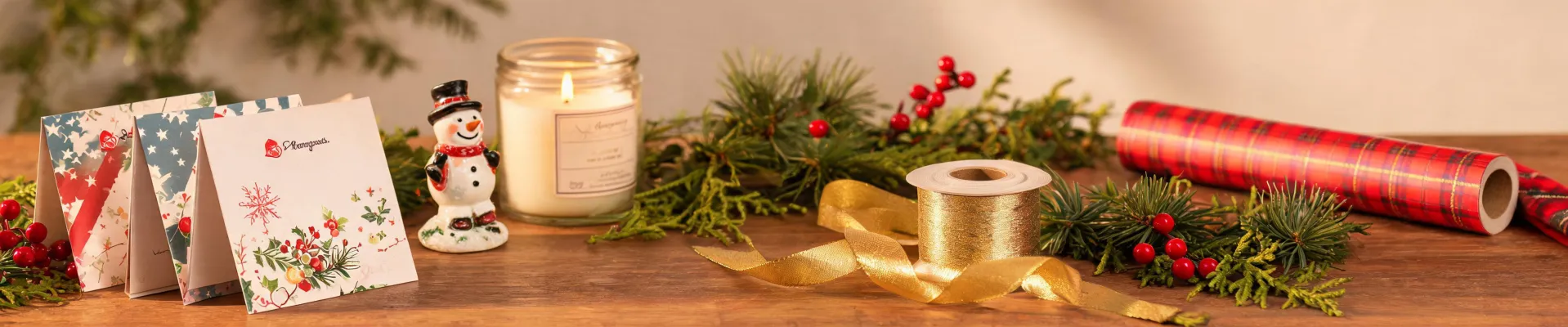
Our first attempt used a generic card, plain red wrapping paper, and a pre-printed insert. It was safe. It was also forgettable. When I compared the old generic package to the coordinated American Greetings version side by side—same gift card, same candle, same box—I finally understood why the details matter so much. The old one felt like a utility bill. The new one felt like a present.
What changed on paper was simple: an American Greetings Christmas card, then American Greetings Christmas wrapping paper that matched the card design. I know that sounds cosmetic. It isn't.
What I mean is that the wrapping paper and the card are the context for everything else. If you put a generous gift card inside a report envelope, the message is 'I know I should send something.' If you take the time to wrap it in paper that looks deliberate, the message changes. The gift gets opened differently. That delayed moment of recognition is usually where the 'oh, this is nice' happens—or doesn't.
2. I ignored the postal anatomy of a card
Cards are not just cards. They have size and thickness. We designed a beautiful card with a folded insert, metallic ink, and a wax seal. Don't send a wax seal through the mail unless you want a machine to eat it. The result was a piece of mail that was too rigid, too thick, and too expensive to mail as a letter.
According to USPS pricing effective January 2025: First-Class Mail letter (1 oz) is $0.73; large envelope (1 oz) is $1.50; additional ounce for large envelopes is $0.28. USPS defines a letter as up to 6.125 inches x 11.5 inches and no more than 0.25 inch thick. Larger or rigid mail is a flat, and it gets a different rate.
Source: USPS pricing and mail specifications at usps.com, as of January 2025.
We didn't know that. We printed, inserted, sealed, and mailed a stack of oversized envelopes. A week later, they came back marked postage due. The wrong card size cost $450 in redo plus a one-week delay.
3. Votive candles almost sank the whole package
In September 2022, the votive candle almost sank the whole package. We bought eighty votives from a wholesale supplier. The warehouse had no temperature control. On the day we shipped, the sun hit the loading dock. By the time clients opened the boxes, many candles had softened, deformed, or lost their wicks.
I don't have hard data on how many votive candles survive a warm truck in December. But based on the boxes that came back, my sense is that about twenty of the eighty were affected. Not a total disaster. Enough to look incompetent.
The fix for that first batch was embarrassing: I had to look up how to melt wax candle properly before we could re-pour the broken ones. That's the moment I learned the difference between a candle as inventory and a candle as a gift component. A candle is not paper. It's heat-sensitive cargo.
4. We treated small clients like they were small
This is the one I'm least proud of. In our second year, we almost dropped a startup that wanted just 12 gift sets. It didn't feel worth the effort. We still sent them—with less care than the big accounts. And they noticed.
Look, small doesn't mean unimportant. It means potential. When I was running my own small business before this job, the vendors who treated my $200 orders seriously were the ones I kept coming back to for $20,000 orders. I should have remembered that earlier.
The real cost of getting it wrong
Let me put a number on the damage. My first corporate gift order: $3,200 in direct costs. Result: zero meaningful follow-up. The candle disaster in 2022 cost $890 in redo plus a one-week delay. And the trust loss is harder to count.
I've personally made (and documented) 47 significant mistakes over seven years of handling this. The wasted budget is somewhere north of $12,000. I'm not saying that number to impress you. I'm saying it so the next person doesn't have to repeat it.
The fix: a checklist that keeps us honest
After the third packaging failure in Q1 2024, I sat down and wrote a checklist. Since then, we've caught 47 potential errors before they went out. Not because we're smarter. Because we wrote down what we learned.
- One coordinated set. Use American Greetings Christmas cards and American Greetings Christmas wrapping paper that match. The card and wrap should feel like one intentional package.
- Measure the mail before you print. If a card is thicker than a standard letter or has rigid inserts, plan for the large envelope rate. Don't let a beautiful card become a returned delivery.
- Test candle shipments under real conditions. Put a votive candle in a sample box, leave it in a warm warehouse for two days, then ship it to your own address. If it arrives damaged, fix the packaging or the temperature before you send it to clients.
- Give small orders the same care. The startup that buys 12 sets today may need 1,200 next year. Small doesn't mean unimportant—it means potential.
To be fair, no checklist can guarantee a client's reaction. That's not the point. The point is to stop losing credibility over things you can control.
We still make mistakes. Last spring, I approved a quote with the wrong die-cut line, and the print file had to be recreated. But the big, reputation-damaging mistakes stopped. Not because we're smarter. Because we wrote down what we learned.
That's it. That's the whole system.

Elise Laurent
Elise Laurent is a crystal and decorative glass quality analyst covering crystal figurines, vases, ornaments, suncatchers, and gift glassware. She examines ISO 6486-1 where food-contact glass dinnerware applies, then uses polarized strain inspection, dimensional checks, surface-defect grading, and refractive clarity to compare decorative pieces outside that scope. Her work helps sourcing teams choose materials, finishing routes, and protective packaging without confusing visual brilliance with verified durability.