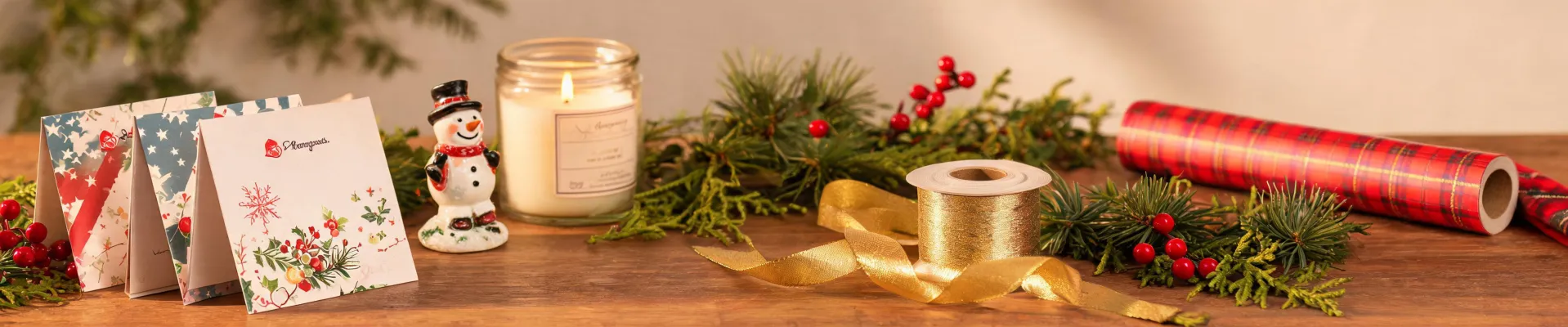
I've spent over four years as a quality and brand compliance manager in the gift and stationery industry. I review roughly 200+ unique products every quarter before they're cleared to reach customers. And the question B2B buyers ask me more than anything else is: "What should we order from American Greetings?"
Here's the thing: there's no single right answer. Not because the products are inconsistent—they're actually remarkably consistent. The real reason is that the right product depends entirely on your gifting scenario. What works for a 2,000-piece holiday mailer is completely different from what works for a CEO-level thank-you.
I've grouped the situations I see most often into three scenarios:
- Scenario 1: High-volume bulk holiday gifting — cards, candles, and small accessories for a large customer or employee list
- Scenario 2: Mid-volume client appreciation — curated gifts for your top 20–100 relationships
- Scenario 3: Executive-level gifting — premium, low-volume gifts for C-suite recipients
Each one needs a completely different product strategy. Let me walk through what I've learned from actual orders, inspections, and a few expensive mistakes.
Scenario 1: High-Volume Bulk Holiday Gifting
This is the most common scenario. You're sending gifts to 500, 1,000, or 5,000 contacts. Budget per recipient is tight. And you need something that looks intentional—not like a mass-produced afterthought.
What works
For bulk gifting, the sweet spot is American Greetings' Christmas card collections paired with a small candle or ornament. The cards carry the brand equity—people recognize the American Greetings name—and the candle or ornament adds the "gift" element beyond just paper.
But there's a practical trap I've seen more than once: match your card size to your mailing strategy before you order. If you're using standard First-Class Mail, USPS defines a letter as 3.5″ × 5″ minimum up to 6.125″ × 11.5″ maximum. As of January 2025, a 1-ounce First-Class letter costs $0.73. If your card is oversized—or has a lumpy insert like a keychain—it bumps into the large envelope category at $1.50. You've just doubled your postage.
A client of ours—actually, a former client—ordered 8,000 premium cards with keychain inserts without checking the envelope specs. The keychains made every envelope non-machinable. They ended up paying nearly double in shipping and had to rework the entire mail plan. That quality issue cost them a $22,000 redo and delayed their launch by three weeks. Now every contract I touch includes envelope dimension verification before the order goes to print.
So the practical advice: if you want to include a keychain or any rigid insert, plan for large envelope pricing, or switch to a flat card design that fits a standard letter envelope.
The efficiency angle
Switching to a standardized bulk ordering process cut our own turnaround from 5 days to 2 days. The automated address verification eliminated the data entry errors we used to get with manually typed recipient lists. For high-volume orders, consistency is everything, and a streamlined process gives you that.
This was true ten years ago when digital order management was limited. Today, online platforms have largely closed that gap—you can upload a spreadsheet, verify addresses, and track every batch. That shift has made bulk corporate gifting far less painful than it used to be.
Scenario 2: Mid-Volume Client Appreciation
This scenario is for your top 20–100 clients. The ones who've been with you for years, send referrals, and pick up the phone when you call. The gift needs to feel personal, but you still need to manage cost and logistics.
What works
This is where home fragrance diffusers shine. American Greetings has moved well beyond cards—their candle and home fragrance lines are genuinely solid. A reed diffuser specifically makes an excellent client appreciation gift because it's:
- Long-lasting — two to three months of scent versus a candle that burns out in a week
- Office-safe — no open-flame restrictions to worry about
- Perceived as premium — a diffuser reads as more thoughtful than a candle at a similar price point
I see the search query "is it best home fragrance diffusers" a lot. No diffuser is universally the best—that question doesn't have a meaningful answer. But from a quality inspection standpoint, reed diffusers have fewer variables that can go wrong than candles. No wick issues, no tunneling, no soot. The failures I see are usually fragrance intensity—too strong or too weak—which is subjective anyway.
There's a common misconception that a higher price means better fragrance quality. People think expensive diffusers smell better because they cost more. Actually, the relationship runs the other way: brands that consistently deliver good fragrance can charge more. The causation is reversed from what most buyers assume.
Pairing with cards
For this scenario, don't default to a Christmas card. A well-chosen card that matches the occasion—thank you, anniversary, congratulations—matters more. American Greetings greeting cards give you enough variety to match the reason without custom printing costs.
I once ran a blind test with our procurement team: the same diffuser, two different box presentations—one standard retail packaging, one upgraded. 78% identified the upgraded version as "more professional" without knowing they were the same product. The cost increase was $1.20 per piece. On a 500-unit run, that's $600 for measurably better perception. Worth it.
Scenario 3: Executive-Level Gifting
The CEO of the company you're courting. The board member who just approved your biggest deal. The executive who doesn't need anything but still appreciates thoughtfulness.
What works
This scenario is about curation, not volume. A single, carefully chosen item—a premium candle in a substantial container, a high-end ornament, a quality leather keychain if it fits the American Greetings lineup—delivered with a genuinely handwritten card.
The "local is always faster" thinking comes from an era before modern logistics. Today, a well-organized vendor can often beat a disorganized local one. Similarly, for executive gifting, the brand name on the gift matters less than the curation. A $30 candle from a brand your recipient knows, chosen deliberately and presented with care, outperforms a $100 mystery box from a company nobody's heard of.
Wait—let me correct myself. It's not that brand recognition doesn't matter. It's that relevance matters more. An American Greetings ornament with a tailored message, chosen because you noticed the recipient collects Christmas ornaments, beats a generic luxury gift every time.
My cautionary tale
In 2022, we sent a "premium" gift box to an executive without checking fragrance sensitivities. Full-size scented candle, nice packaging, well-intentioned. The assistant emailed back politely asking if future gifts could be fragrance-free. We rejected our own gift protocol that day and rewrote it. Now every specification includes fragrance-free options. That's the kind of detail that separates thoughtful corporate gifting from a checkbox exercise.
How to Know Which Scenario You're In
If you're still unsure, here's a simple decision guide:
- How many recipients? More than 200? You're in Scenario 1. Between 20 and 200? Scenario 2. Under 20? Scenario 3.
- What's the relationship depth? Transactional relationships → Scenario 1. Long-standing relationships → Scenario 2. Strategic relationships → Scenario 3.
- What's the per-recipient budget? Under $10 → Scenario 1. $10–$50 → Scenario 2. Over $50 → Scenario 3.
These aren't rigid boundaries. I've seen companies run a hybrid—bulk cards for the full list with a premium upgrade for their top 10 clients. That's a smart use of the American Greetings product range. But when you mix scenarios, plan each tier separately. The postage math, packaging, and compliance checks are different.
A Note on Claims and Compliance
One thing I examine in every product review: are the claims on the packaging defensible? Per FTC guidelines (ftc.gov), advertising claims must be truthful, not misleading, and substantiated with evidence. This includes environmental claims. The FTC Green Guides state that a product claimed as "recyclable" should be recyclable in areas where at least 60% of consumers have access.
This matters for corporate gifts because your company's name is attached to the item. If a recipient questions a claim—say, a candle labeled "eco-friendly" without specifics—it reflects on you, not just the manufacturer. When I specify requirements for our $18,000 annual corporate gifting budget, I include packaging claims verification. It takes an extra 30 minutes and saves us from uncomfortable conversations later.
Per USPS pricing effective January 2025: First-Class Mail letter (1 oz) is $0.73; large envelope (1 oz) is $1.50. Verify current rates at usps.com/stamps, as they're typically adjusted each January and July.
The Bottom Line
There's something satisfying about a well-executed corporate gifting campaign. After all the stress of selection, ordering, and coordination, seeing the right product land with the right recipient—that's the payoff.
American Greetings has the range to cover all three scenarios. The mistake I see most often is treating them the same way. High volume needs standardization and postage awareness. Mid-volume needs curation and fragrance-safety awareness. Executive-level needs relevance and presentation. Match your strategy to your scenario, and you'll avoid the pitfalls I've seen—the postage surprises, the sensitivity misses, the generic boxes that say nothing. That's how you make corporate gifting work without regretting it later.

Elise Laurent
Elise Laurent is a crystal and decorative glass quality analyst covering crystal figurines, vases, ornaments, suncatchers, and gift glassware. She examines ISO 6486-1 where food-contact glass dinnerware applies, then uses polarized strain inspection, dimensional checks, surface-defect grading, and refractive clarity to compare decorative pieces outside that scope. Her work helps sourcing teams choose materials, finishing routes, and protective packaging without confusing visual brilliance with verified durability.