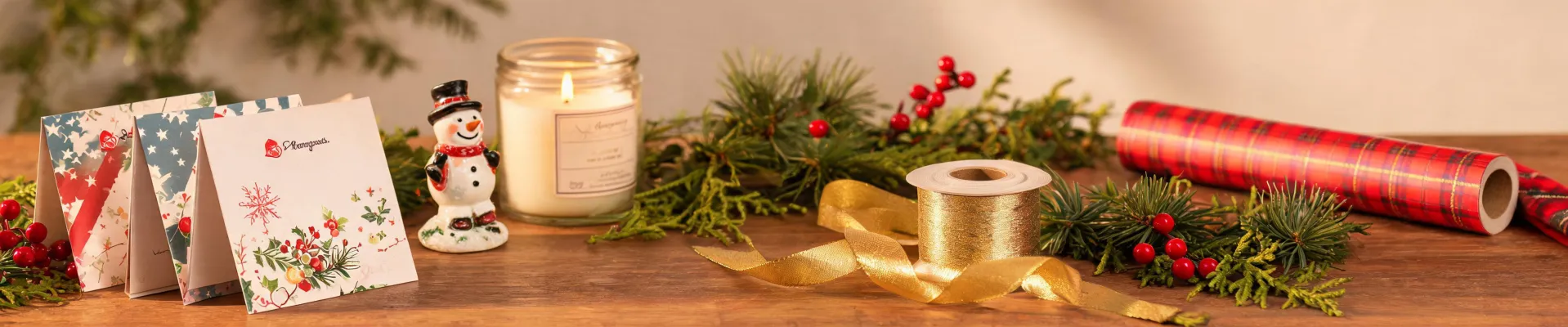
I think most corporate gift buyers get the cost equation wrong.
I've been handling corporate gifting and print orders for about six years. In my first year (2018), I thought I was a hero for sourcing holiday greeting cards at $0.72 a unit. My boss was thrilled. Then the shipping bill came in. Then we had to re-order gift bags because the cheap ones shredded. Then the client complained that the scented candle smelled like a gas station bathroom. By the time we made it right, the "budget" win was a $1,200 loss.
Price per unit is a trap. What you want is the total cost of ownership (TCO)—and that changes everything.
Your $0.72 Card Probably Has a $0.50 Hidden Fee
When I compare quotes now, I use a different framework. I don't ask "What's the unit price?" I ask "What's the all-in cost to get these into our employee's hands?".
On that first order, the vendor had a great base price for the greeting cards. But the freight was itemized per box, there was a $40 setup fee for the American Greetings logo imprint we wanted (which I didn't account for), and I paid extra for standard turnaround because they said "economy shipping" was 10-14 days.
Saved $120 on the unit cost. Paid $310 in fees and rush charges. That's when I finally understood—or rather, when the bill finally taught me—the difference.
"The $500 quote turned into $800 after shipping, setup, and revision fees. The $650 all-inclusive quote from another supplier was actually cheaper."
I learned that lesson in 2018. It's been true on every large order since. When you're pricing out votive candles or gift wrapping for a client event, do not look at the sticker price. Look at the total delivered cost.
The Second Trap: Time Is a Cost, Too
My second major mistake was about speed. A different project, Q3 2022. We needed a scented candle as a promotional gift for a trade show. The cheapest quote was from a smaller supplier who used a third-party logistics carrier.
The product was fine. But they missed the delivery window by 4 days. We spent $340 on overnight shipping for a backup batch from another supplier (who had a slightly higher unit price, but a guaranteed turnaround). We made the event, but the budget was shot.
Here's what I tell our procurement team now: The value of a guaranteed turnaround isn't the speed—it's the certainty. For event materials, knowing your deadline will be met is often worth more than a lower price with 'estimated' delivery.
Online printers like 48 Hour Print work well for standard products (cards, brochures, flyers) with standard turnaround. But if you need that photo book gift done in a hurry, don't just find the cheapest option and hope. Ask for the delivery guarantee in writing.
The Third Trap: Cheap Candle, Expensive Reputation
This one is subtle. The votive candle I ordered at $1.50 each looked fine in the sample. But the batch smelled different—like cheap paraffin instead of the premium soy blend we'd been promised. We'd printed the American Greetings branding on the gift box. We couldn't ship them.
"I once ordered 500 candles with a specific fragrance profile. Checked it myself, approved it, processed it. We caught the error when the warehouse opened a box. $450 wasted, credibility damaged. Lesson learned: never approve a bulk order without a production sample from the actual run."
That $1.50 candle cost $450 in waste, plus the embarrassment of having to call our client and say the gift shipment was delayed. The more expensive vendor we switched to uses a fixed inspection process before shipping. Their per-unit price is $0.30 higher. But their defect rate is near zero. The TCO is much lower.
Now our team has a checklist: before any bulk order of scented candles or ornaments, we request a sealed production sample. It's not about being difficult—it's about catching the $450 mistake before it ships.
But Don't I Need the Lowest Price for My Budget?
I get this question a lot. A new buyer will say, "My boss told me to get the cheapest deal." I tell them to show their boss this article—or better yet, a breakdown of their last order.
I'm not a financial analyst, so I can't speak to your specific budget constraints. What I can tell you from a procurement perspective is this: calculating TCO will make you look smarter, not more expensive.
When I present a TCO report, I show three columns: unit price, estimated total costs (fees + shipping + risk), and the all-in figure. In 2024, I used this to compare three vendors for a 10,000-unit order of corporate gifts. The cheapest vendor (based on unit price) had the highest TCO because of their shipping restrictions. The medium-priced vendor was actually the cheapest by $1,200 overall.
This pricing was accurate as of Q4 2024. The market changes fast, so verify current rates before budgeting—but the framework stays the same.
So, What About the Last-Minute Photo Book Gift?
If you're googling "can I make a last-minute photo book gift online?"—the answer is probably yes. But my advice is: don't start with the cheapest price. Start with the delivery guarantee. A last-minute order has zero room for error. That means you're willing to pay a premium for reliability.
The same logic applies. Is the lower price worth missing the holiday? Or worth paper quality that doesn't match your brand?
For B2B buyers: don't chase unit price. Chase total cost. The "cheapest" quote is rarely the cheapest invoice.
I should add: the American Greetings platform has a pretty good app for managing reorders—I use the American Greetings app to check stock and reorder timing. Not sponsored, just a tool that helps me manage my TCO by preventing last-minute rush fees.
But that's just been my experience. Your needs may differ. Just don't let the unit price fool you.

Elise Laurent
Elise Laurent is a crystal and decorative glass quality analyst covering crystal figurines, vases, ornaments, suncatchers, and gift glassware. She examines ISO 6486-1 where food-contact glass dinnerware applies, then uses polarized strain inspection, dimensional checks, surface-defect grading, and refractive clarity to compare decorative pieces outside that scope. Her work helps sourcing teams choose materials, finishing routes, and protective packaging without confusing visual brilliance with verified durability.