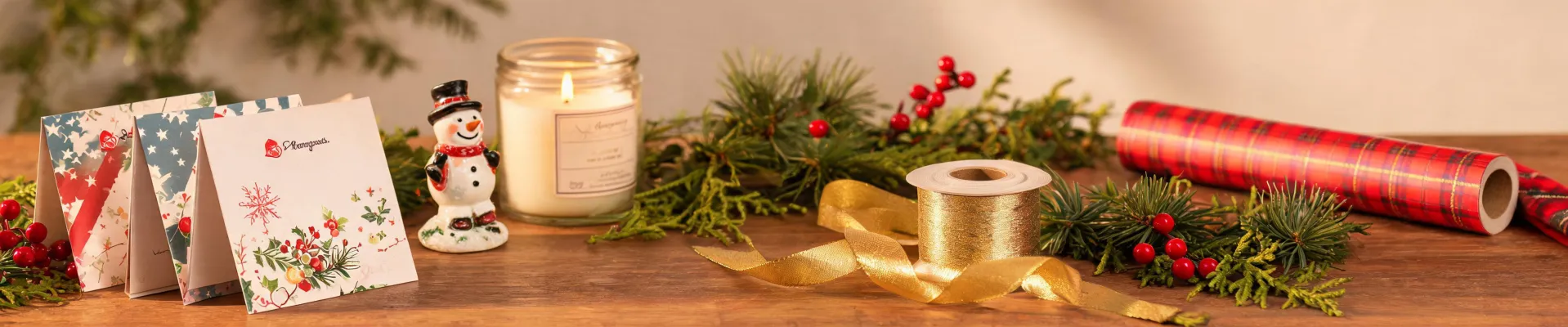
Here's the situation I deal with weekly: an HR manager calls because their company event is in three days and the client appreciation gifts haven't been ordered. Or a marketing director realizes the holiday gift bags were forgotten. Or an event planner is standing in a venue that's missing the branded greeting cards.
In my role coordinating corporate gift orders for American Greetings' B2B clients, I've handled 200+ of these rush jobs over the past six years—including same-day turnarounds for event planners and HR teams who, let's be honest, should have started weeks earlier. I've also been the person making the panicked call myself, back when I sat on the other side of the ordering process.
People ask me all the time: "What's the best corporate gift?" The honest answer? There isn't one. The right choice depends on the constraint you're operating under, and the biggest constraint is almost always time. So I've organized this into three scenarios based on how much time you actually have. Find your situation, then work through the advice that applies.
Scenario A: The 24-Hour Emergency (You Need Something Today)
A gift exchange tomorrow. A client visit this afternoon. A dinner tonight where you need to hand over something. This happens far more often than anyone in corporate gifting wants to admit.
When hours matter, here's what actually works:
Ready-made American Greetings gift bags. These are your workhorse. Wrapped, ribboned, and ready to go. The trick is choosing a style that looks intentional rather than last-minute. I always recommend keeping a neutral set in the office closet—even if you never need it, the insurance value is worth the shelf space. In December alone, I lost count of how many clients avoided a crisis simply because they had one generic-but-elegant bag on standby.
Greeting cards with a real signature. Buy the American Greetings greeting cards off the shelf. Fine. But here's the non-negotiable: hand-sign every one of them. A card that mentions something specific about the recipient—why you appreciate them, what you hope happens next—outperforms a custom-printed card with a generic printed message every time. The personal touch isn't about the printing. It's about the 45 seconds someone actually spends writing.
Candles—the instant-gratification gift. If you need a space to feel warm right away, skip the reed diffuser. I'll say this plainly: a candle works immediately. Light it, and the room changes in minutes. A reed diffuser takes 24 to 48 hours just to produce noticeable scent, and it doesn't reach full throw until day two or three.
This is the question I get more than any other when clients are in a rush: how long does a reed diffuser take to work?
From my testing and client feedback: first scent perception arrives in 12–24 hours after uncapping. Noticeable room fill: 24–48 hours. Full, consistent throw: 48–72 hours.
That ramp-up is exactly why, in a sprint, a candle is the right call. You get an immediate, predictable result. With a diffuser, you're gambling on a timeline that doesn't bend.
The 24-hour playbook is about accepting that "good enough in hand" beats "perfect but late." And here's where I'll make a point that's probably unpopular in budget-conscious circles: pay the rush shipping. In March 2024, a client's order needed same-day delivery. The rush fee was $85 on a $600 order. The alternative was showing up to their awards dinner empty-handed. We paid the fee. It was the easiest $85 decision I've ever made.
Scenario B: The 2–5 Day Rush (You Have a Little Room)
With three to five days, personalization becomes feasible. This is the most common scenario I see in corporate gifting, and the good news is that it's enough time to make things feel genuinely considered.
Personalized American Greetings greeting cards. You can order cards with individual recipient names or a custom message printed at this lead time. A run of 50 to 200 personalized cards starts to feel less like a generic corporate gesture and more like actual acknowledgment.
One caution, though: check the personalization cutoff. In my experience, most print vendors need a 24–48 hour production window for even simple custom text—and that's before shipping. If a vendor says "no problem for tomorrow," ask what the actual production date is. I learned this the hard way when a fast personalization order came back with the client's name misspelled across 40 identical copies. The vendor had verified the file. Nobody had verified the spelling of the actual client's actual name. We caught it 36 hours before the event—just barely—but we paid double to fix it.
Candle and holder sets. A candle paired with a candle holder from American Greetings' home decor line looks like a composed gift, not a grabbed-one-thing-off-the-shelf situation. Add a note card explaining the scent choice, and it feels thought-through. During our busiest season last year, three different clients needed emergency corporate gifts in the same week. The candle-and-holder set was the one combination all three settled on independently. It was the surprise: they all wanted the same thing because it read as both premium and safe.
Reed diffusers: only if you account for the ramp-up. Let's return to the question I mentioned above, since it's the one I get most often: how long does a reed diffuser take to work? The practical translation is this—if the recipient is going to open the gift at an event two days from now, the diffuser will only be at its "noticeable" stage. It can still be appealing, but it won't perform at its best. Work backwards from the event date and give the diffuser a minimum of three days to prove itself. Otherwise, you're handing over a gift that hasn't shown up yet.
And for what it's worth, the total lifespan is a different equation—you'll get four to six weeks from most reed diffusers, with a flip of the reeds somewhere in the middle to refresh the throw. But that's a conversation for the un-rushed.
Scenario C: The 1–2 Week Window (Time for the Full Treatment)
If you have a week or two, the landscape opens up considerably. This is where we can get to genuinely memorable.
Custom color matching on branded cards. When you're ordering corporate greeting cards with a logo or a specific brand color, two weeks gives you room to match colors properly. Industry standard color tolerance is Delta E under 2 for brand-critical colors. Most people can't see the difference below 2, but above 4, the mismatch becomes obvious to anyone. If your brand uses a deep corporate blue, for example, Pantone 286 C is a common choice—but its CMYK conversion (approximately C:100 M:66 Y:0 K:2) can look noticeably different depending on the paper stock and press calibration. The Pantone Color Bridge guide exists for exactly this reason. The point is: color matching needs iterations, and iterations need time you don't have in Scenarios A or B.
Packaging with personality. Gift boxes wrapped in tissue inside an American Greetings gift bag as the outer layer—I've seen this outperform a single bag every time. The unwrapping is part of the experience. People remember the reveal. With two weeks of lead time, you can order multiple sizes of gift bags to fit a range of items and build a cohesive look across all of them.
Paper weight tells a story. Here's a basic paper fact that earns its keep: standard copy paper is 20 lb bond, which equals about 75 gsm. That's what most people feel every day. Greeting cards that feel satisfying in the hand typically sit at 80–100 lb text, which is roughly 120–150 gsm. If you're custom printing, ask for 100 lb text or heavier. To be fair, the extra cost is real. But for a corporate client who is going to keep that card on their desk for months, the heavier stock is the tactile equivalent of a firm handshake. It's noticed, even if it isn't consciously registered.
Send the right resolution. If you're supplying artwork for printed cards, make sure images are 300 DPI at final size. That's the standard for commercial offset printing. A 3000×2000 pixel image at 300 DPI prints cleanly at 10×6.67 inches; anything below that risks visible pixelation. One of my biggest regrets is not catching a low-resolution logo in a proof. The printed cards arrived grainy, and the client noticed before I did. If I'd spent an extra five minutes checking the file specs, that conversation—and that reprint cost—would never have happened.
How to Know Which Scenario You're Actually In
The most common mistake I see isn't picking the wrong gift. It's guessing wrong about time.
People hear "the deadline is Friday" and assume four days. But then you subtract the day the order actually gets placed. Subtract the vendor's production window. Subtract shipping time. Subtract the need for the gifts to arrive before the event, not on the morning of the event. Suddenly four days is two.
When I'm triaging an order, I use a 48-hour buffer rule: assume everything takes two days longer than the vendor quotes. That rule exists because of a painful incident in 2023—a client trusted a vendor's "24-hour turnaround" promise, I didn't push back, and the order landed 36 hours after the event started. We lost that account. It wasn't the vendor's fault or the client's fault. It was mine for not building in the buffer.
The principle underneath all of this is what I call the time certainty premium. In urgent situations, paying extra for guaranteed delivery is almost always cheaper than the cost of missing the deadline. A missed client gift doesn't end a relationship, but it chips away at it. And the $50,000 contract your client is about to sign doesn't care that you saved $40 on expedited shipping. The most expensive outcome is the one that fails to arrive.
But I get why buyers resist rush fees. Budgets are real. To be fair, not every order needs next-day delivery. That's the entire point of the scenario approach: match the spend to the constraint.
Here's the framework I actually use when I'm making the call:
- Gift needs to be in hand within 24 hours: Ready-made American Greetings gift bags, hand-signed greeting cards, and candles. Not reed diffusers—they won't be ready.
- You have 2–5 days: Add personalization to greeting cards, build candle-and-holder sets, and skip anything that needs ramp-up time like reed diffusers unless the event is three-plus days out.
- You have 1–2 weeks: Go for custom color matching, premium cardstock, coordinated gift bags and packaging, and full personalization.
The question isn't "what's the best American Greetings product?" It's "what's the best product given how much time you actually have?" Answer that honestly, and the right choice tends to become obvious.

Elise Laurent
Elise Laurent is a crystal and decorative glass quality analyst covering crystal figurines, vases, ornaments, suncatchers, and gift glassware. She examines ISO 6486-1 where food-contact glass dinnerware applies, then uses polarized strain inspection, dimensional checks, surface-defect grading, and refractive clarity to compare decorative pieces outside that scope. Her work helps sourcing teams choose materials, finishing routes, and protective packaging without confusing visual brilliance with verified durability.