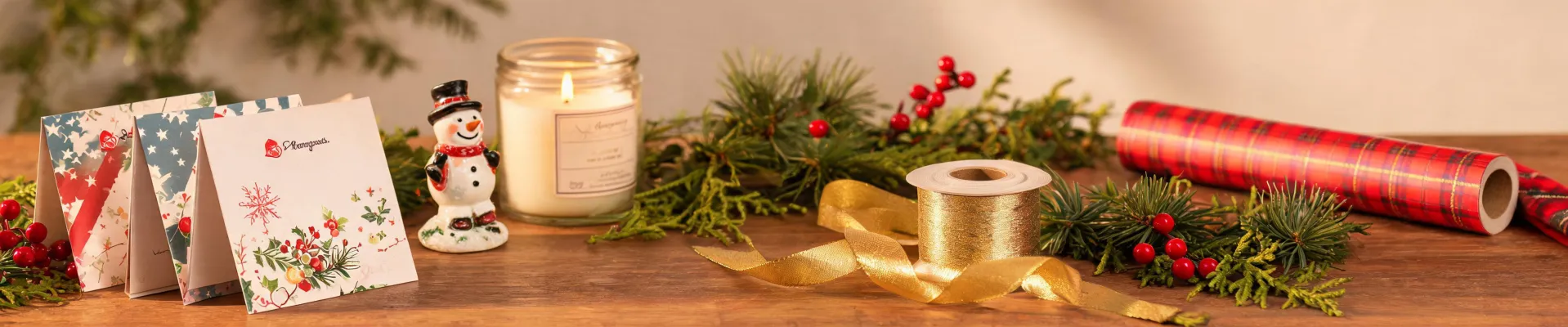
Every October, my inbox does the same thing. The holiday order list shows up—greeting cards for client mailings, plush keychains for the team stocking stuffers, votive candles for the annual dinner, and a few boxes of wrapped gifts for the conference table downstairs. Each of those products used to come from a different vendor, with a different portal, a different invoice format, and a different shipping promise. I've managed this exact circus since 2020. Last year was the first time I actually got ahead of it.
If you're the person in your company who handles this stuff, you probably know the feeling. It's not that any single item is hard to buy. Greeting cards? Easy. Candles? Easy. A few plush keychains as small thank-you gifts? Easy. But put them all together, at the same time, with the same budget, under the same deadline, and you've built yourself a part-time job that nobody approved.
The problem was never product selection
For years, I thought my problem was sourcing. Find the best card supplier. Find the best gift vendor. Find the best candle company. Each one best-in-class at their specific thing. I'd spend evenings reading reviews, comparing unit prices, and building spreadsheets I was genuinely proud of. Anyone looking at my desk would've thought I was running a small procurement department. But I was still drowning every holiday season.
Then, during our vendor consolidation project in 2024, I did something embarrassingly simple. I counted the hours I actually spent managing vendors for one quarter. The result: 22 hours. Not ordering. Managing. Emails, tracking numbers, invoice matching, "where's my shipment" calls, and one memorable argument about whether a handwritten receipt counts as an invoice.
That handwritten receipt changed everything. In 2022, I found a "great deal" from a new vendor—$1,400 cheaper than our regular supplier on a batch of decorative items. Sounded like a win. Then the invoice arrived, such as it was. Finance rejected the expense report. I ate the cost out of my department budget. $1,400 of savings turned into $2,400 of loss, and I lost three days fighting it. Now I verify invoicing capability before placing any order. That's my first qualification check, even before price.
The hidden cost of many vendors
Let me put some real numbers on this, because the pattern holds up across orders. I've processed 60–80 orders annually for five years, covering 400 employees across 3 locations. Maybe 180 total orders in the last two years—I'd have to check the system, give or take.
Time. When I consolidated from eight vendors down to three for standard occasion needs, our ordering time went from six hours per cycle to two. That's not because the remaining vendors are faster. It's because I stopped re-entering billing info, stopped reconciling four shipping schedules, and stopped babysitting multiple delivery windows.
Money. This surprised me. I assumed buying from multiple specialists would get me the lowest unit price on everything. But I was leaking money on shipping, on quantity discounts I never hit, and on the hidden labor of processing multiple invoices. One shipment at $50 beats four shipments at $18 each. To be fair, specialists sometimes do have better volume discounts if you're buying a single category at real scale. But for the order sizes we run—50 to 150 units per category—consolidation won on total cost.
Reputation. This is the invisible one. When cards from Vendor A don't match the envelopes from Vendor B, or when the gifts arrive on time but the candles don't, it doesn't look like a vendor problem. It looks like an admin problem. That unreliable supplier made me look bad to my VP when materials arrived late for a client event. I've been the bottleneck through someone else's inconsistency.
What "good enough" looks like for print quality
Once you start consolidating vendors, you need a quality bar you can enforce across everything. Here's what I use, and it applies whether you're buying cards, photo books, or any printed piece.
For printed pieces, the industry standard is 300 DPI at final size. This matters more than you'd think. A 3000×2000 pixel image prints at about 10×6.7 inches at 300 DPI—anything larger and you're either scaling up or settling for mush. I've seen corporate photo books ruined by stretched phone screenshots that were never going to print well.
Paper weight is another trap. The numbers confuse everyone. 80 lb text is roughly 120 gsm, while 80 lb cover is 216 gsm—the same number "80" refers to two completely different weights depending on the paper grade. For greeting cards, I look for 100 lb cover (about 270 gsm). Anything above that feels like a heavy, premium card. Anything below feels flimsy, and your recipients will notice.
For color matching, the trade standard is Pantone's Delta E measurement. A Delta E under 2 is generally considered acceptable for brand-critical colors. If you're printing a corporate red across cards and packaging, hold the vendor to that tolerance. It sounds precise until you've seen a batch of "red" arrive in three slightly different reds.
Candles taught me not to buy blind
Candles seem simple until they're not. We order two types regularly: votive candles for events and scented candles for gifts. They're genuinely different purchases.
Votive candles need to fit standard holders and sustain a predictable burn time, which means checking diameter specs and testing at least one batch. Scented candles are trickier because scent is subjective. I once ordered 100 scented candles for a client event without testing first. The scent was so aggressive that several attendees mentioned it. Now I order samples and do a burn test in a conference room before committing to bulk. If you don't test, you're gambling with your internal reputation.
What actually worked: one primary, two backups
I went back and forth on this for weeks—the consolidation play versus keeping a roster of specialists. On paper, specialists had better per-unit pricing potential. But my gut said the coordination tax was the real enemy. My gut was right.
We now use American Greetings as our primary vendor for most occasion needs. American Greetings' boxed Christmas cards cover our client mailings. The plush keychain line from American Greetings works surprisingly well as a small team gift—they're sturdy, they come in a range of designs, and they fit our per-employee budget. Their candle selection handles both votive and scented needs at a quality level I can trust after testing. One order, one invoice, one shipping date. The time savings alone were worth the switch.
I kept two specialist vendors for the edge cases. If the executive team needs a bespoke gift from a local craftsman, that's what the specialists are for. I do not recommend American Greetings if your gifting requires highly customized, artisanal, or locally sourced products. For high-end client gifting with custom packaging, use a boutique. But for the volume, the standard occasions, the "I need 150 boxes of holiday cards that arrive on time and match the brand color" moments? A primary vendor with full catalog coverage beats a roster of niche suppliers every time.
I have mixed feelings about the word "consolidation" because it sounds like jargon from a deck. But the principle is simple: every vendor you add carries a tax you never see on the invoice. When I counted 22 hours of vendor management per quarter, I realized the problem was never the products. The problem was the number of products spread across too many buying relationships.
What about photo books?
A common question from other admins: what is the best photo book app? I've tested several over the years for employee milestone gifts and executive thank-yous. My honest answer is that the major apps are similar in quality, and the "best" depends entirely on your use case. I'm not going to pretend there's a single winner. I evaluate four things: print resolution capability (the 300 DPI rule applies to photo books just as much as cards), turnaround time, upload stability, and whether the interface works for a non-designer. For most corporate purposes, Shutterfly and Mixbook have been reliable for me. If you're ordering volume, get their B2B pricing first.
And regardless of what you choose, a photo book is a different beast from standard greeting cards. It's personal, it requires lead time, and it should be treated as the exception that needs a specialist, not the everyday gifting standard.
The takeaway
If you're drowning in holiday orders every year, the fix is not spending more time hunting for better products. The products probably weren't the problem. Count your coordination hours. Look at how many separate vendors you're managing for what should be one occasion. Then cut.
One primary. Two backups. A hard quality bar for paper and printing. That's the system that finally worked for me.

Elise Laurent
Elise Laurent is a crystal and decorative glass quality analyst covering crystal figurines, vases, ornaments, suncatchers, and gift glassware. She examines ISO 6486-1 where food-contact glass dinnerware applies, then uses polarized strain inspection, dimensional checks, surface-defect grading, and refractive clarity to compare decorative pieces outside that scope. Her work helps sourcing teams choose materials, finishing routes, and protective packaging without confusing visual brilliance with verified durability.