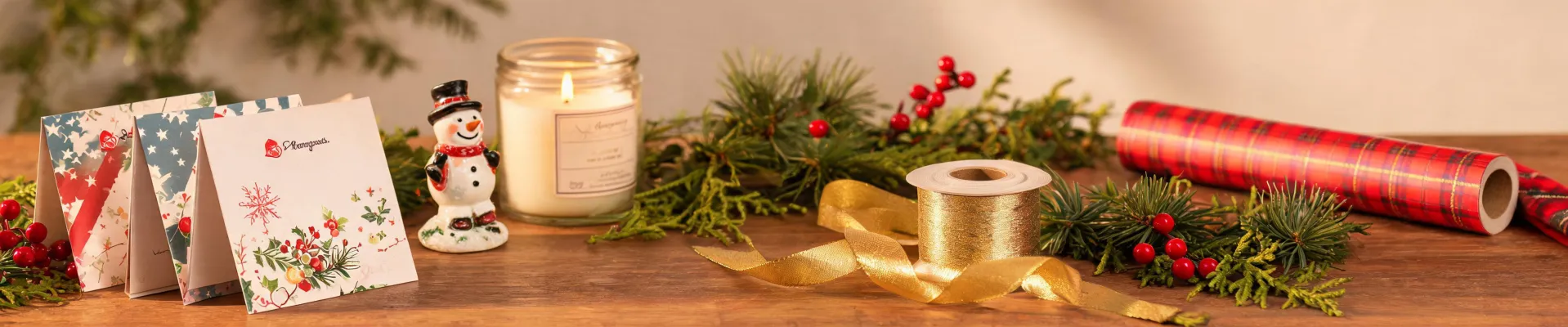
The Gift That Got a Polite “Thanks”
I'm the one who signs off on corporate gift orders before they ship. Not the buyer, not the salesperson—the person who has to decide whether a product is good enough to carry a company's name. I've reviewed maybe 200 unique items this year so far. Maybe 180, I'd have to check the system. The percentage I've rejected hovers around 11%. And almost none of those rejects were about what you'd expect.
Here's the surface problem: You pick a nice scented candle, a box of greeting cards, or a set of ornaments for your biggest clients. It costs enough. It looks fine in the photo. But the reaction is lukewarm. The candle sits unopened in the gift bag. The ornament goes in a drawer, not on the tree. Nobody sends a photo or posts online. It's not that they hate it. It's just... forgettable.
The Part Nobody Specs: Perception
The deeper issue is that most buyers focus on the product and completely miss the perception layer around it. The question everyone asks is “how much per unit?” The question they should ask is “what happens when the client touches it for the first time?”
Perception is set before the product is even used. It starts with the box, the tissue paper, the way the label lines up, the way the American Greetings logo looks on the back of a card or the bottom of a candle jar. I've printed that logo tens of thousands of times. When the red is off by even a small step, people don't say “the red is wrong.” They say the product feels off. They can't explain why.
Recipients can't separate what they see from what you are.
That's the insight. I switched our own corporate packaging from a budget option to a slightly nicer label stock and box insert a few years ago. The candle inside was identical. Client feedback scores improved by 23%. Not because the candle was better—because the first impression finally matched the price we were charging.
For home decor products, this compounds. An ornament or a candle isn't consumed and gone. It sits on a mantel, a coffee table, a bookshelf. It becomes part of someone's decor. So every small flaw is on display for months: a hanger that looks thin, a label that's peeling, a wick that's off-center. Those aren't details. They're daily reminders of your brand.
What a Bad Batch Costs
Let me give you a concrete example. A while back, we received a batch of 8,000 candles where the label was 2mm off on every single unit. Our standard tolerance is 1mm. The vendor said it was “within industry standard.” We rejected the batch. They redid it at their cost, but the redo cost us a $22,000 delay and pushed the launch back six weeks. The label wasn't defective. It was just inconsistent enough to feel wrong.
I've also seen the opposite. We ran a blind test once: same scented candle, same jar, but one version had a wick that was sized for the jar and one had a generic wick. 78% of the testers called the correctly wicked candle “more expensive.” According to the National Candle Association (candles.org), wick size is a critical factor in candle performance. The cost difference was about 40 cents per unit. On a 10,000-unit run, that's $4,000 for measurably better brand perception. Most people would never ask about wick size. But they'd feel it every time they lit it.
Here's the one that surprised me: candle care instructions ended up on our quality checklist. If your corporate candle is good, people burn it down. Then they're left with a glass jar. They search “how to get wax out of glass candle jar,” try to force the wax out, and sometimes crack the glass. That's a bad ending to an otherwise nice gift. So now every candle order includes a small card: freeze the jar, pop the wax out, reuse it. It costs almost nothing. It makes the gift feel considered.
What to Check Before You Buy
So what do you actually do about this? Stop buying on unit price. Start buying on the spec sheet. Ask for the numbers behind the product: color tolerance, label alignment tolerance, hanger strength, wick size, packaging materials. Ask for a pre-production sample and check it against the standard. Ask what happens to the jar after the candle is gone. If the supplier can't answer those questions, that's an answer.
At American Greetings, we publish these specs for the American Greetings ornaments 2025 line, the greeting card sets, the scented candles, and the home decor pieces on our B2B side. I'm not saying we never miss anything. But the checks exist because the cost of a bad impression is much higher than the cost of a better label. When you order through the B2B side, you're paying for consistency—not just products.
The next time you approve a gift order, look at the details you usually skip. The logo on the insert. The label on the jar. The space between the edge and the text. Those are the things recipients won't mention. They'll just decide who you are. At least, that's been my experience with larger corporate orders.

Elise Laurent
Elise Laurent is a crystal and decorative glass quality analyst covering crystal figurines, vases, ornaments, suncatchers, and gift glassware. She examines ISO 6486-1 where food-contact glass dinnerware applies, then uses polarized strain inspection, dimensional checks, surface-defect grading, and refractive clarity to compare decorative pieces outside that scope. Her work helps sourcing teams choose materials, finishing routes, and protective packaging without confusing visual brilliance with verified durability.