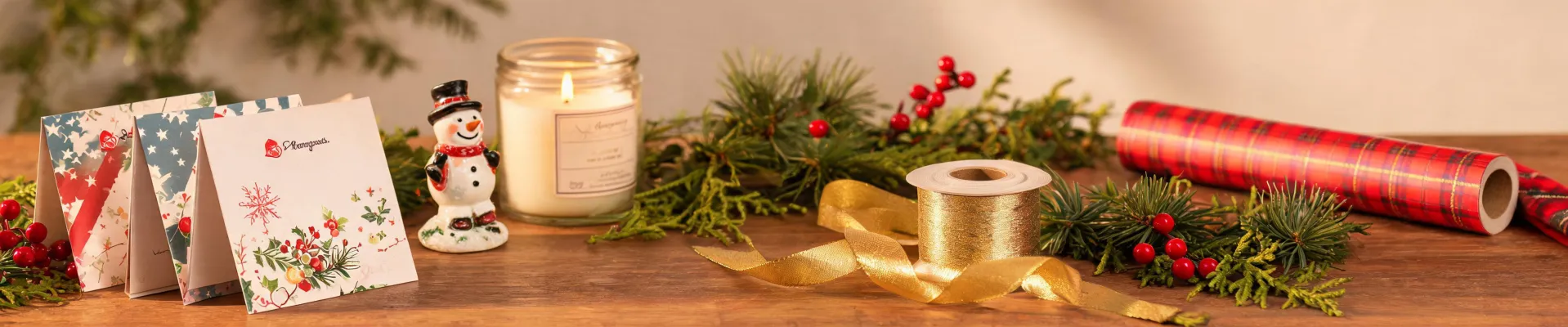
After four years of reviewing American Greetings products—boxed Christmas cards, gift bags, home decor, candles, and crystal gifts—I've rejected about 8% of first production runs. Not because the products were terrible. Because "looks good on a sample" and "consistent across 5,000 units" are two entirely different things.
The conclusion I keep landing on: In corporate gifting, consistency of small details beats premium materials every single time. A box of Christmas cards where every color matches, every envelope is sealed the same way, and every insert sits at the same angle—that's what a client remembers. Not the fancy finish. The consistency.
Most buyers assume quality issues are visible. A scratch on the glass. A smudged print. In reality, the defects that cost us the most were invisible: slight color drift against a Pantone reference, handle tension varying by 40% across one gift bag batch, candle jars that only cracked after the wax burned down. The kind of issues you can't catch until the client already has the product in their hands.
I'm the quality compliance manager at American Greetings. I review every corporate-facing product line before it ships to B2B customers. In Q1 2024 alone, I rejected three deliveries—a total of 8,000 units—over issues that would've passed a casual inspection. That's not bragging. It's the job.
Roughly 200+ unique items pass through my hands each year. Over time, patterns emerge. I've seen what fails in production, what breaks in transit, and what customers actually notice. Here's the breakdown.
Boxed Christmas Cards: Color Fidelity Is the Battleground
Here's something vendors won't tell you: the "same" product can vary in color between production runs. It's not malicious. It's ink chemistry, substrate absorption, and press calibration—all of which drift over time.
American Greetings boxed Christmas cards hold color to a Delta E of under 2 for brand-critical colors. For context, Delta E measures color difference. A Delta E of 2-4 is noticeable to trained observers; above 4 is visible to most people. When a corporate client orders 2,000 boxes of cards with their logo on them, a red that misses the mark by Delta E 4.6 doesn't just look off. It signals brand sloppiness. To their clients.
The Pantone Matching System is our common language here. Pantone's Color Bridge guide also makes clear that CMYK equivalents are approximate. What you see on a screen will never exactly match a printed card. That's why pulling physical samples during production matters, and why "good enough" doesn't exist when you're printing someone's corporate identity.
The expensive lesson came during our 2022 audit. We received a batch of 3,000 boxed Christmas cards where the green was visibly off—Delta E 4.6 against our standard. The vendor claimed it was "within industry standard." We rejected the batch, and they reprinted at their own cost. Now every contract includes a color tolerance clause.
Gift Bags: The 90-Second Test
American Greetings gift bags seem simple. They're not. The most common failure isn't tear strength or print quality. It's how the handles attach.
I run a 90-second test on every batch: loaded weight, handle tension, bottom gusset integrity. No lab equipment. Just a quick manual check that catches roughly 75% of the defects our full lab audit classifies as critical.
The test exists because a bag can pass every standard spec—paper weight within tolerance, correct dimensions, clean printing—and still fail the moment someone puts a bottle of wine in it and a handle pulls clean off. Static inspection won't catch that. Stress testing will.
In 2024, about 4% of our gift bag rejects were for inconsistent handle tension within a single batch. Some handles held 10 pounds; others gave way at 2.5. They looked identical. They weren't.
Candle Jars: The Wax Removal Question
We get the same question from corporate clients over and over: how to remove the wax from a candle jar? Most people treat this as a cleaning topic. I'd argue it's a quality topic. Because a well-designed candle jar is reusable—but only if the wax comes out cleanly.
Our testing shows that jars with smooth inner walls and wide mouths are significantly easier to clean. That sounds obvious. But surprisingly few candle jars on the market get both right. A beautiful jar that's impossible to clean becomes trash. A client who receives your branded candle set either reuses those jars—keeping your brand visible in their home—or throws them away. One outcome builds brand presence. The other doesn't.
The method we recommend: place the jar in a small pot of water and heat slowly until the wax softens and separates from the glass. Never pour boiling water directly into a cold jar—that creates uneven thermal stress and can crack the glass under ASTM impact standards. Wipe away any remaining residue with a paper towel, then wash with warm, soapy water.
We've also seen the opposite failure in testing: jars that survive heat just fine but crack in the dishwasher. The end customer doesn't care about your material spec. They just know the jar split.
Home Decor & Crystal Gifts: Packaging Is Part of the Product
Counterintuitive take: the product you sell isn't the product you ship. The product you ship is product plus packaging, as one system.
For American Greetings home decor and crystal gifts, we test the complete package—item, padding, carton, void space—as a unit. Transit vibrations can cause micro-cracks in crystal that aren't visible on delivery but shatter under later stress. That's why we require full-contact packaging for crystal gifts rather than loose fill. Loose fill lets items shift during transport. Full-contact form fit prevents it.
The hard lesson was a $22,000 redo in 2023. A client's crystal gift order passed every inspection we ran—until the items sat on a truck in cold weather. The glue holding the foam inserts softened in the cold. The crystal slid in the box. Retailers returned 12% of the order. We covered the cost and rewrote our packaging spec to include thermal tolerance testing.
There's something satisfying about shipping a product that survives all the ways the world tries to destroy it. After weeks of coordination, seeing a delivery arrive intact—that's the payoff.
What We Don't Do (And Why That's a Quality Feature)
I'll say this plainly: American Greetings doesn't make everything. We don't custom-manufacture bespoke crystal awards. We don't do single-run fine-art stationery. And I'm okay with that. In fact, it's why quality holds up.
The vendor who says "this isn't our strength—here's someone who does it better" earns trust for everything else.
I've built vendor relationships on that honesty. When a client asks for something outside our core product lines, we'd rather point them to a specialist than deliver a mediocre version. That boundary protects the buyer and protects our brand.
Part of me wants to say "yes" to every client request. Another part knows that staying in our lane is what keeps quality high. I reconcile it by remembering: clients come back because we consistently deliver well on what we do—not because we occasionally deliver okay on everything.
The Limits of What I Know
A few honest caveats. First, this reflects my experience with American Greetings' B2B channel. What I know about retail product behavior is secondhand. Second, these audits are from 2023–2024. Product lines change, and current specifications may differ. The principles hold up, but verify current information before making procurement decisions.
I'm also not formally quality-certified. No Six Sigma black belt. What I have is four years of field-level observations across 200+ unique products, an 8% first-delivery rejection rate, and a long list of patterns. That's real, but it's one person's view.
If you're sourcing corporate gifts, my advice is simple: ask your supplier how they define color tolerance, how they test handle strength, and how they package fragile items. If they can't answer, that's your 8%.

Elise Laurent
Elise Laurent is a crystal and decorative glass quality analyst covering crystal figurines, vases, ornaments, suncatchers, and gift glassware. She examines ISO 6486-1 where food-contact glass dinnerware applies, then uses polarized strain inspection, dimensional checks, surface-defect grading, and refractive clarity to compare decorative pieces outside that scope. Her work helps sourcing teams choose materials, finishing routes, and protective packaging without confusing visual brilliance with verified durability.