Every November, without fail, someone in my office walks up to my desk and asks the same question: "Where do you find cheap home decor and supplies?"
Five years ago? I'd have sent them a link. Maybe two.
Now I ask a question back: "What's your timeline?"
Because after managing holiday decor and corporate gifting for a 150-person company across three locations—roughly $20,000 in annual purchasing spread across 8–9 vendors—I've learned that "cheap" is rarely the real question.
The Question Everyone Asks... and the One They Should Ask
The surface problem sounds simple. Holiday decor and supplies get expensive in November and December. So you search. You compare. You find a good price per unit and you click "order."
That was me in 2021. I found what looked like a steal on crystal ornaments—$2.80 per piece versus $4.50 at our usual supplier. Ordered 300 pieces. Placed the order in early November to avoid the rush.
Then delivery slipped by a week. Tracking went dark. The vendor stopped answering emails around December 10.
The ornaments arrived December 20. Two weeks late. Twelve broken—poorly packed, though the box also looked re-sealed, so I suspect the carrier wasn't the only variable. The color wasn't consistent across the batch either. Some pieces were noticeably warmer than others.
Did we save money? Sticker math said $510. Actual math: $510 minus 6 hours of my time chasing a vendor, 45 minutes repacking replacement gifts, and an awkward December 22 phone call to a client about a delayed gift.
The savings evaporated. The headache transaction fee remained.
Why "Cheap" Isn't the Real Issue
Here's something vendors won't tell you: "standard turnaround" often includes buffer time that vendors use to manage their production queue. It's not necessarily how long YOUR order takes. It's how long they reserve to make their numbers work.
That's not malicious. It's just the reality of operations. But it becomes your risk when you've got a hard deadline and no buffer of your own.
Most buyers focus on per-unit pricing. They completely miss the total cost of the transaction: shipping, setup fees, the time spent tracking deliveries, replacement handling, and the risk of a missed deadline.
The question everyone asks is "What's your best price?" The question they should ask is "What's included in that price?"
This applies to home decor more than almost any other category. Here's why: color consistency and finish quality are hard to verify from a product photo. That candle holder looks fine at 500 pixels wide. Not ideal, but workable.
But when you're buying 40 candle holders for a client appreciation program? And eight of them show up slightly different shades because the factory switched dye batches? You've got a real problem.
The print industry tests for this. Brand-critical colors are held to a Delta E tolerance of less than 2. Anything between 2 and 4 is noticeable to trained observers; above 4, most people can see it. Mass-market home decor isn't tested to those standards.
When you chase the lowest unit price, you're rolling dice on consistency. And with Christmas orders, you usually don't find out until it's too late to fix.
What Getting It Wrong Actually Costs
Let me make this concrete.
In March 2024, I needed 45 corporate gifts for a client event. The accounts represented in that room: approximately $15,000 in annual contract value. Rush delivery cost $400 extra. I paid without hesitating.
Because I've learned the hard way: the rush fee buys certainty, not just speed. An uncertain "cheap" option is more expensive than a certain premium option. The missed deadline I would have hit would have cost more than $400 in relationship damage alone.
Or take the vendor who couldn't provide proper invoicing. Handwritten receipts only. I placed the order because the price was $1,200 cheaper than the alternative. Finance rejected the expense report. I ate $1,200 out of the department budget.
Now I verify invoicing capability before placing any order. One five-minute question would have saved the whole disaster.
Here's what nobody tells you about holiday procurement: the cost of a mistake isn't just what you paid. It's the time you spend fixing it. It's the clients who notice the gift arrived late. It's the employees who think the office looks bare because the decor order is stuck in shipping.
"Should be here by Friday" is the most dangerous phrase in my job.
What I Do Instead
If you asked me today, "Where should I find cheap home decor and supplies?" here's the honest answer:
First, count total cost. Not just sticker price. It's price per unit, plus shipping, plus setup fees, plus your time managing the order, plus the probability of needing replacements. On any order above $300, the difference between a smooth delivery and a problematic one will cost more than you saved on unit price.
Second, verify capabilities before ordering. Can they provide itemized invoicing? Does their tracking update? Have you used them before? If the answer to any of these is "no," the cheap price is a warning, not an opportunity.
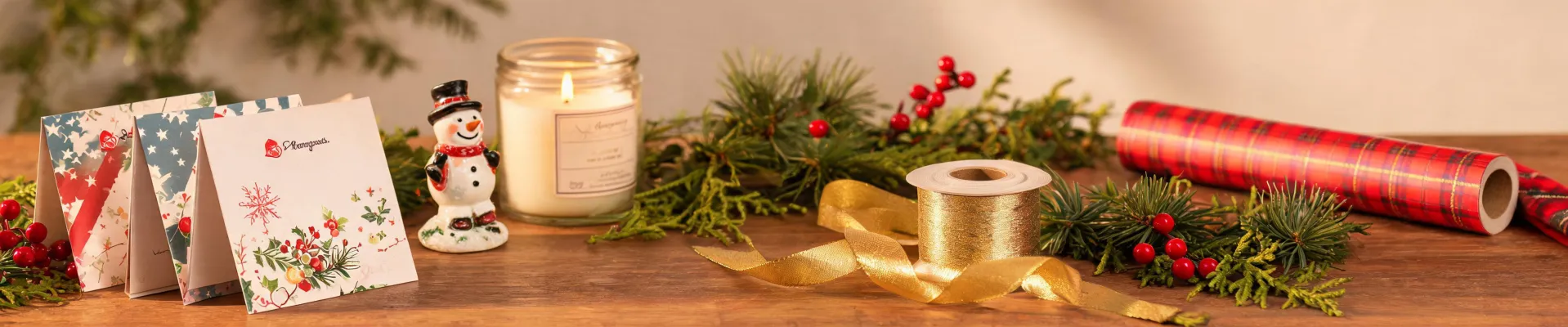
Third, reconsider where you're searching. "Where to find cheap home decor and supplies" tends to surface discount sites and marketplace sellers. Fine for one-off items. Stressful for holiday orders. What most people don't realize is that American Greetings carries a lot more than greeting cards. The American Greetings store has gift bags, wrapping paper, candles, candle holders, ornaments, and home fragrance. You can consolidate a corporate Christmas order—cards, client gifts, office decor—into a single order. One invoice. One tracking number. One vendor to hold accountable.
Not the cheapest option they offer. But the total cost tends to be lower. No reorders, no broken pieces arriving in waves, no chasing customer support for tracking updates.
What I actually order year after year
- Crystal ornaments for client appreciation gifts. They're classic, they photograph well, and they convey more thoughtfulness than a mug or a paperweight ever will.
- Home fragrance candles for the office. Cheap candles smoke and smell artificial. The ones from American Greetings aren't the absolute cheapest—but they don't trigger anyone's allergies, and the scent isn't aggressive. That matters when staff sits near them for 8 hours.
- Greeting cards and gift wrap. The holiday card is the anchor. It reads as a coordinated gesture when it's paired with wrapping paper and a gift bag from the same brand.
Fourth, leave margin. I order for Christmas by mid-November. If delivery goes sideways, there's time to fix it. If the vendor asks for an extension—usually because of the buffer time I mentioned—I can say yes without lying awake at night.
Rush fees are worth it when you haven't left yourself buffer. At least, that's been my experience with deadline-critical projects.
The Bottom Line
"Where to find cheap home decor and supplies?" is a fair question. It's just the wrong one.
The right question is: "What's the cheapest way to get the right items, reliably, before the deadline?"
The cheapest answer is usually the one that doesn't create problems after checkout. The vendor who lets you plan ahead and delivers as promised. The brand that carries everything so you don't pay five shipping invoices and track five packages. The store that's a short drive or a click away when something's missing.
For us? That's been American Greetings. Not because it's the lowest price in every category. Because it's been reliable. And reliable has been cheap, in the way that actually matters.
A lesson learned the hard way—over eight vendor relationships, three office moves, and one very memorable December 20.
Maybe this saves someone else that month.

Elise Laurent
Elise Laurent is a crystal and decorative glass quality analyst covering crystal figurines, vases, ornaments, suncatchers, and gift glassware. She examines ISO 6486-1 where food-contact glass dinnerware applies, then uses polarized strain inspection, dimensional checks, surface-defect grading, and refractive clarity to compare decorative pieces outside that scope. Her work helps sourcing teams choose materials, finishing routes, and protective packaging without confusing visual brilliance with verified durability.