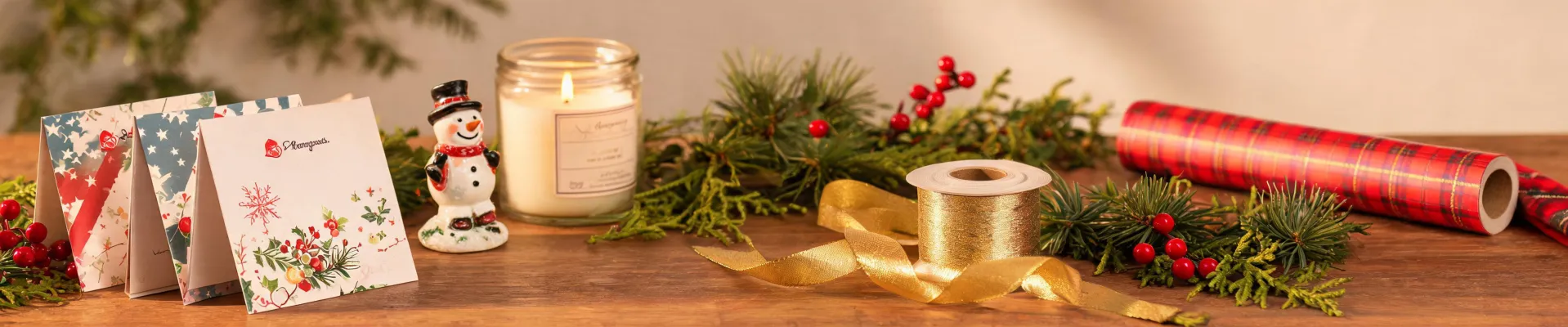
I'm a procurement manager at a mid-sized software company. I've managed our corporate gift budget for six years—roughly $18,000 a year, if you count candles, cards, packaging, and the occasional free-shipping fiasco—and I keep every invoice in a cost tracking system. I'm not a candle scientist. I just spend money on candles that are supposed to be good enough to send to a client.
Maybe you're in a similar spot. You buy a nice scented candle, light it once, and by day two the fragrance is gone. Or the wax tunnels and leaves a wall of wasted wax. It feels like user error, but typically it's not.
The surface problem: candles burn unevenly before you finish the first third
The most common complaint I hear is tunneling. The flame burrows down the middle, leaves a thick ring of wax on the sides, and eventually drowns the wick. Most of us assume it's because we didn't keep the first burn going long enough. The first burn matters, sure, but it can't fix a wick that's too small for the candle's diameter.
Think of it as a compact car pulling a trailer. You can press the pedal, but the engine is still wrong for the job. I've flagged this on candles from almost every gift supplier we've ordered from. The packaging says clean burn and the wick says otherwise.
To make sure it wasn't just our imagination, I pulled data from last year's order. Candles that listed a wick size (something like standard for a 3-inch jar) had a much lower complaint rate than candles with no wick spec at all. It's not peer-reviewed research, but it's enough for me to avoid vague product descriptions.
One year, I asked for a mild scent. The vendor delivered a candle that smelled like a cinnamon distillery. I said mild scent. They heard less intense. Result: a conference room that smelled like a holiday store for two weeks. That's a communication failure, not a candle defect—but it taught me to check specs before ordering.
The deeper reason most candles don't last: you lose scent before you light them
Here's the part that surprised me. A scented candle does not need to be burning for its scent to disappear. If it sits uncovered on a shelf, the fragrance compounds are quietly evaporating into the room. That's why a candle that smells amazing at the store can be nearly odorless by the time you bring it home—or worse, months later when you finally use it.
I'm not sure why more candle brands don't mention this. My best guess is that lids are easy to overlook and shrink-wrap is not a very sexy feature. In our order history, candles that shipped with fitted lids performed much better than the ones that arrived naked in a box. At least, that's been my experience with mid-size corporate orders, not with single candles on a dining table.
There's also light exposure. Fragrance oils degrade with UV light. A candle sitting in a bright window is slowly losing whatever made it smell good in the first place.
So when you ask how can I make my scented candle last longer? the first honest answer is: start with a candle that hasn't already lost half its scent before you bought it.
What bad candles actually cost, not just in dollars
Let me give you a real example. Last year we ordered about 120 candles for client gifts—maybe 115, I'd have to check the system—and each one cost $22 plus a $1.50 greeting card insert. That's roughly $2,800 in the cost tracker. Seven months later, after feedback from recipients, we found 18 of those candles had tunnelled badly or barely smelled. Eighteen out of 120.
Replacing those 18 candles cost us about $400. But the real cost was the awkward note that went with them, plus the hunch that some clients never told us. If we had spent an extra $4 per candle on a better wick and a lid, it would have been $480. That's practically a wash compared to $400, and we'd have avoided the whole problem. That's the difference between unit price and total cost of ownership.
Another angle. If the candle arrives broken or smelling like a cardboard box, you'll have to reship. Reshipping one candle via an expedited service costs around $18. That's not a huge number, but it destroys margin on a $22 product. It also makes you look disorganized, which defeats the whole point of a gift.
How to make a scented candle last longer
Enough about the problem. Here's what actually matters.
- Buy a candle with a wick that matches the container. A 3-inch-wide jar shouldn't have a wick designed for a votive. If the package doesn't say, look for reviews that mention tunneling.
- Store it with a lid on. If it didn't come with one, keep it in the box. You're slowing down scent loss.
- Burn the first session long enough for the melt pool to reach the edges. It's a helpful baseline, not a magic fix for a bad wick.
- Trim the wick to about 1/8 inch before each burn. A short wick produces a smaller flame and less soot. Around 1/8 inch works for most jars.
- Keep candles out of drafts and direct sun. Drafts make the flame dance. UV light degrades fragrance.
That's the full list. You don't need a 12-step ritual or a candle warmer. (A warmer can help if you want scent without burning, but it's not required.)
What this means if you're buying corporate gifts
A candle and greeting card combo is one of the safest corporate gifts we use. The card is what makes it a gift rather than an invoice. The candle is what makes it memorable. As a corporate gift, a candle and card set works because it feels personal without being too specific.
The American Greetings store has a solid selection of candles, holders, and ornaments if you're building a few gift bundles. And the American Greetings greeting cards website home page lets you add a card to the same cart, which matters when you're ordering in bulk and don't want to chase separate shipments.
Honestly, I don't know why some gift suppliers still put skinny wicks in wide jars and skip the lid. My best guess is they're betting on packaging rather than burn experience. That's backwards, because the first thing your recipient does is open it and light it.
Anyway, the next time a candle doesn't last, don't blame your technique. Check the wick, store it covered, and buy from a place that treats the candle like a product to use, not just a product to photograph. That's the biggest fix. That said, we've only tested American Greetings candles on smaller orders so far, but they've held up well enough to stay on our list.

Elise Laurent
Elise Laurent is a crystal and decorative glass quality analyst covering crystal figurines, vases, ornaments, suncatchers, and gift glassware. She examines ISO 6486-1 where food-contact glass dinnerware applies, then uses polarized strain inspection, dimensional checks, surface-defect grading, and refractive clarity to compare decorative pieces outside that scope. Her work helps sourcing teams choose materials, finishing routes, and protective packaging without confusing visual brilliance with verified durability.