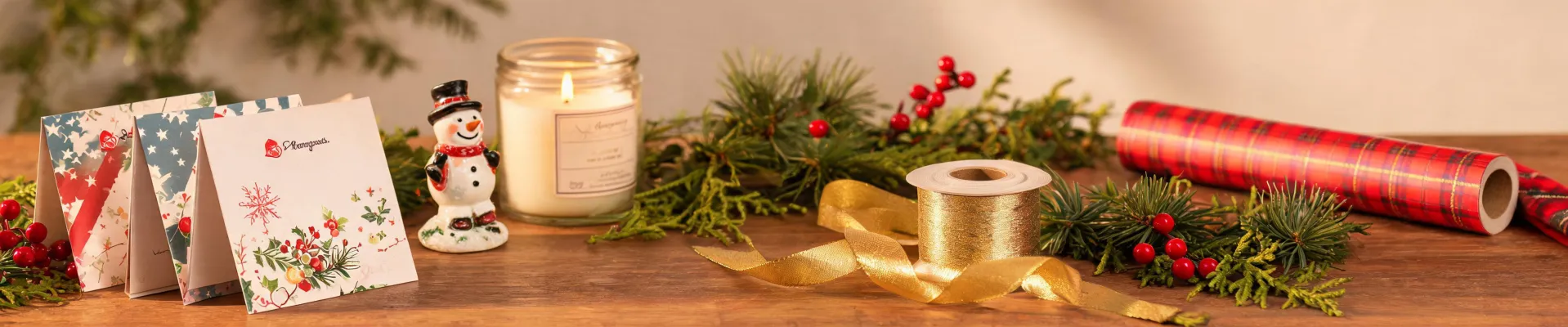
If you've ever watched a client unwrap a corporate gift, you know that split second when their face tells you everything. The polite smile. The slightly-too-long pause before they say "thank you." You can't always tell if they genuinely like it—but you can usually tell when they don't.
In November 2023, we found out exactly what that looks like at scale. 150 branded candles, ordered from a budget supplier. They looked great in the box. Glass jars with our logo, clean packaging, a familiar gift no one would feel awkward opening at their desk.
But candles don't stay in the box.
The surface problem: soot, tunnels, and a LinkedIn post nobody tagged us in
Three weeks after the gifts went out, the emails started. A client's office manager asked about "the black stuff" around the rim of the jar. Another client said the artificial fragrance gave their assistant a headache (she ended up telling the whole office, which was... fun). A third recipient posted a photo on LinkedIn—half-burned candle, an ugly soot ring, melted wax tunneled down the center.
"Corporate gift of the season." — a LinkedIn post from someone who received our candle
No tag. No mention of our company name. But we saw it. And we knew exactly which candle it was.
The surface issue was clear: we'd sent out a product that performed badly. The fix seemed equally obvious—buy better candles next time.
I was half right. Better wax was the answer. But "buy better candles" was the wrong lesson, because it skipped past what actually went wrong and why.
The deeper causes
It took me a while to see the full picture. Three things were actually going on, and none of them was "the supplier ripped us off."
Cause #1: We chose on unit price, not on experience
People think expensive vendors deliver better quality. Actually, vendors who deliver quality can charge more. The causation runs the other way. We had it backwards: we looked for the cheapest candle that looked expensive, instead of the candle that would still look good halfway through burning.
The supplier's product photos were excellent (too excellent, as it turned out). The $12.80 unit price was excellent. But nobody on our team lit one before we approved the order for 150 units. We never tested the burn, the scent throw, the soot output, or how the glass felt in hand. We ordered a product that was designed to look good in a catalog, not to perform well in an office.
When we compared the budget supplier against the mid-tier option, the upside was $300 in savings. The risk was that the gift would feel cheap. I kept asking myself whether $300 was worth potentially making our company look cheap to 150 clients. I told myself it was. I was wrong.
The $45 sample would have caught everything. I didn't order one. Honestly, I'm not sure why—my best guess is that the holiday deadline was looming and I was moving too fast. That's not an excuse. It's the exact pressure that causes this mistake, over and over, in companies that should know better.
I hit "approve" on the purchase order and immediately wondered if I should have asked for a sample first. I didn't act on that doubt. And then December got busy, and I forgot.
Cause #2: We didn't think about the end of the product's life
Here's the part I really missed. A candle is a gift that keeps revealing itself over time. When it burns down, a glass jar is left behind. With cheap candles, that jar is thin and the wax clings tenaciously to the interior. Cleaning it becomes a chore. What should have become a usable cup or a pen holder turns into "the annoying thing sitting in my drawer."
Our clients started asking us a practical question within three weeks: how do you get the leftover wax out of these jars? At first I thought it was a nice sign—people using the gift. Then I realized it was actually a complaint. We had given our clients homework.
That question threw me. I'd never once considered what happened after the candle burned down. And the answer isn't complicated. Basically, you have three methods for getting wax out of a glass jar, and I'll walk through them below. The reason clients even had to ask is that cheap candles use wax that grabs onto glass, and jars that are too narrow and too fragile to clean. A good candle is designed with its second life in mind. A cheap one isn't.
Cause #3: "Approximately right" became our standard
The packaging was passable. The logo placement was correct. The colors were close. But close isn't a standard.
I learned later that the color tolerance standard for brand-critical work is Delta E < 2 on the Pantone scale. Anything above 4 is visible to most people. Our brand red on the candle labels—printed by the budget supplier—came out looking more orange than red. I noticed it, but I told myself it was "fine" because the label was small.
That was the same logic that got us into the mess. Small mistakes become big impressions when you repeat them 150 times.
What it actually cost us
Let me break down the real numbers, because "cheap" gets very expensive very fast:
- 150 candles at $12.80 each: $1,920
- 12 replacement gifts for clients who complained (or whose assistants complained): $495
- Rush shipping on those replacements: $230
- Roughly six hours of my time on damage-control emails and phone calls: not free, and not small
Total: about $2,645 (this was back in late 2023, at least). The mid-tier candle option we'd initially scoped—the one we skipped to save money—would have cost $2,220 total, with zero replacement spend. The "cheap" route cost us $425 more in direct spending, plus a week of stress, plus a client relationship that still feels cooler than it used to.
I told my boss the cheap candles were a bargain. In reality, they were a luxury item we couldn't afford.
How to melt leftover candle wax in a glass jar
If you're dealing with a candle that left wax behind, here's the safe way to clean the jar. And if you're a business that sends candles as gifts, this is the standard your recipients are silently grading you on.
The freezer method
Put the jar in the freezer for one to two hours. The wax contracts as it hardens and usually pops out in one piece. If it needs a little help, run the outside under warm water (not hot) to loosen the bond. This is the least messy method and it works best on decent-quality jars.
The hot water bath
Place the jar standing up in a pot of water—enough water to come about halfway up the jar. Heat gently until the wax melts, then wipe it out with paper towels while it's warm. Never pour melted wax down the sink. It will clog the drain and your maintenance person will not be grateful.
The oven method
Heat the oven to 150–200°F. Put the jar upright on a baking sheet and let the wax melt slowly. Remove with oven mitts and wipe out. This works well, but check the jar for chips or cracks first—a compromised jar can shatter from the heat.
Whichever method you use, the goal is the same: a clean jar that gets a second life. If the jar is cheap, thin, and poorly shaped, no method will make it pleasant. That's the point.
What we do now
After the candle disaster, I created a pre-gift approval checklist in Q1 2024. It's short:
- Order samples first. Burn them for at least two hours. Check for tunneling, soot, scent throw, and how the jar cleans up after the candle is gone. A $45 sample is cheaper than a $2,645 mistake.
- Demand real standards. For candles: soy or coconut wax blends, cotton or wooden wicks, and jars with smooth interiors and wide mouths. For anything printed: Pantone color matching with Delta E < 2 for brand colors, and 300 DPI minimum resolution for print.
- Think about the end of the gift's life. If the last interaction someone has with your product is frustrating, that's the feeling they associate with your brand. Design for the full arc, not just the unboxing.
That checklist has caught twelve potential issues since we started using it. Not all of them were as dramatic as soot-covered candles, but every single one was an embarrassment we avoided. (note to self: this criterion lives at the top of every vendor evaluation now.)
Why American Greetings became part of our standard
For the 2024 holiday batch, we rebuilt the entire gift system around consistency. The candles came from a supplier who didn't blink when we asked for wax composition data and burn-test videos. And the coordinating pieces—greeting cards, gift bags, wrapping paper, plus a couple of ornaments and keychains for variety—came from American Greetings.
It wasn't the cheapest way to do it. But the American Greetings gift bags feel noticeably sturdier than the flimsy ones we'd used before. The greeting cards matched our brand colors within an acceptable Delta E. The wrapping paper didn't tear at the creases. The ornaments and keychains arrived consistent across the full order. And when we re-ordered in Q1 2025 for a spring client appreciation push, the American Greetings app let us pull our past orders and re-send the same items without re-designing anything. That consistency is half the battle.
To be fair, it's not a full-service corporate gifting agency. If you need custom die-cut packaging, fully managed gift assembly, or a hundred-piece package delivered to individual addresses on specific dates, you'd want a specialized fulfillment partner. But for the core pieces of a standard corporate gift—cards, bags, wrap, candles, small keepsakes—it covers the scope well.
And yes, we still include keychains and ornaments in some of our boxes. Each has its own lessons I've documented. But the candle story is the one that belongs in a "what not to do" talk.
The lesson that stuck
I've been handling corporate gift orders for six years now. The candle order was the most expensive mistake I've made, and it's the one that finally changed how I think about the job.
What you send is a reflection of who you are. The money we saved on cheap products was small; the trust we risked was enormous. Now we sample, we test, and we think about what it's like for a client to use something until the very end.
This approach worked for us—we're a mid-size B2B services company with a predictable roster of about 150 gift recipients. If you're sending thousands of gifts across international borders, your considerations are going to be different. But the core principle holds: sample it, test it, and imagine the recipient's last experience with the item, not just their first.
Take it from someone who learned the hard way.

Elise Laurent
Elise Laurent is a crystal and decorative glass quality analyst covering crystal figurines, vases, ornaments, suncatchers, and gift glassware. She examines ISO 6486-1 where food-contact glass dinnerware applies, then uses polarized strain inspection, dimensional checks, surface-defect grading, and refractive clarity to compare decorative pieces outside that scope. Her work helps sourcing teams choose materials, finishing routes, and protective packaging without confusing visual brilliance with verified durability.